
“Peptic ulcer perforation is a frequent cause of hospitalization, which affects 2–10% of patients with peptic ulcer. Omentopexy is commonly used in emergency management of duodenal ulcer perforation. Omentopexy was first described by Cellen Jones in 1929 and was later modified by Graham in 1937. The surgical approaches for omental patching rely on two principles, that is, direct and indirect omentopexy.”
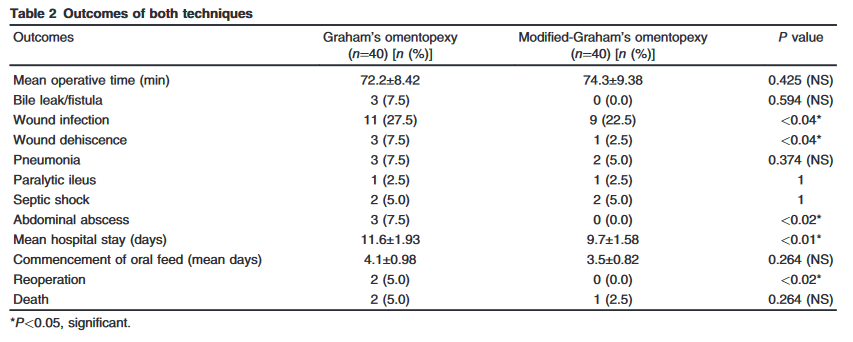
“In modified-Graham’s technique, a segment of omentum is brought on top of the already
approximated perforation with second level of knots. The use of vascularized pedicled omentum besides reducing the risk of cutting through the sutures used for perforation closure also induces neovascularization, which accelerates ulcer healing,”
“Although widely practiced, MGO remains a treatment with appreciable complications whose potential benefits above and beyond the benefit associated with GO have not been clearly demonstrated.”
Abdallah HA, Saleem AEA. Comparative study between Graham’s omentopexy and modified Graham’s omentopexy in treatment of perforated duodenal ulcers. Egypt J Surg. (2018) 37:485–9. Full Text for Emory Users
 Surgical Focus