
“The acute respiratory distress syndrome (ARDS) was defined in 1994 by the
American-European Consensus Conference (AECC). In 2011 (an initiative of the European Society of Intensive Care Medicine endorsed by the American Thoracic Society and the Society of Critical Care Medicine) developed the Berlin Defnition, focusing on feasibility, reliability, validity, and objective evaluation of its performance. Using the Berlin Definition, stages of mild, moderate, and severe ARDS were associated with increased mortality (27%; 95% CI, 24%-30%; 32%; 95% CI, 29%-34%; and 45%; 95% CI, 42%-48%, respectively; P.001) and increased median duration of mechanical ventilation in survivors (5 days; interquartile [IQR], 2-11; 7 days; IQR, 4-14; and 9 days; IQR, 5-17, respectively; P.001).”
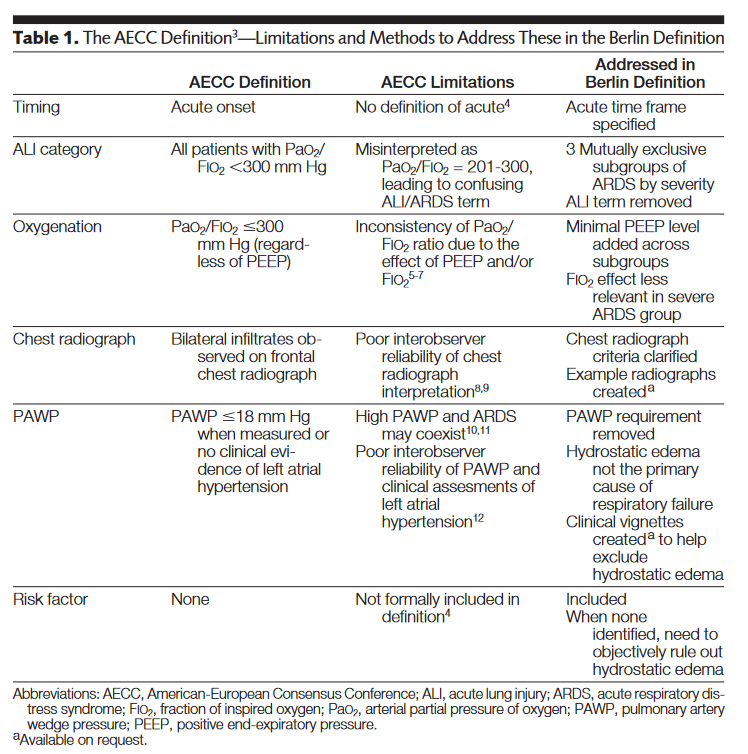
“The Berlin Definition addresses some of the limitations of the AECC definition, including clarification of the exclusion of hydrostatic edema and adding minimum ventilator settings, and provides slight improvement in predictive validity. Our study presents data on the outcomes of patients with ARDS defined according to the Berlin Definition in a large heterogeneous cohort of patients including patients managed with modern approaches to lung protective ventilation. Estimates of the prevalence and clinical outcomes of mild, moderate, and severe ARDS can be assessed from this database for research and health services planning.”
ARDS Definition Task Force; Ranieri VM, et al . Acute respiratory distress syndrome: the Berlin Definition. JAMA. 2012 Jun 20;307(23):2526-33. Full Text for Emory Users
 Surgical Focus