
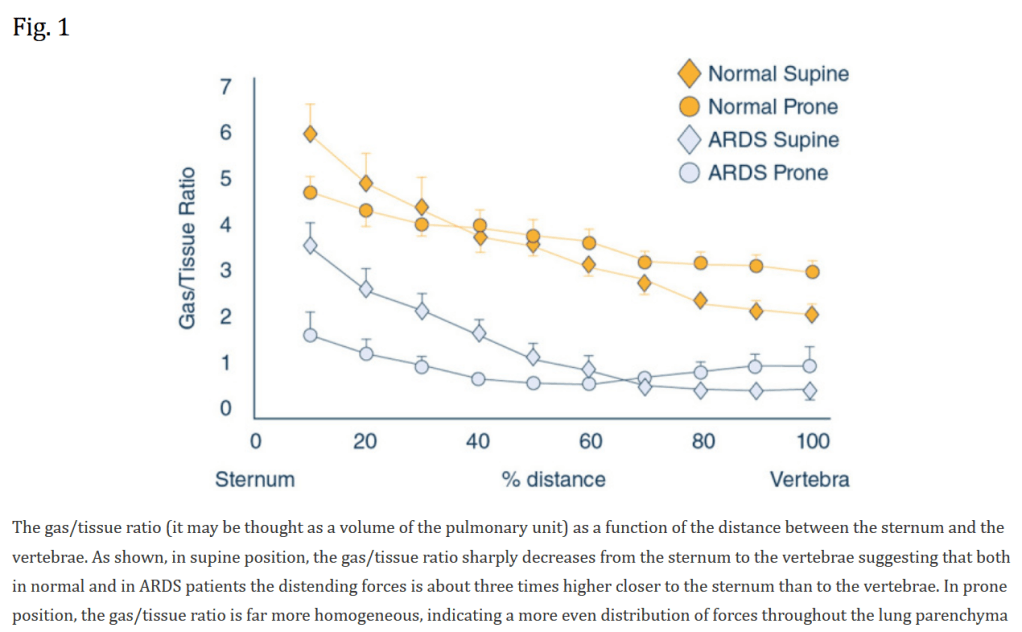
“In ARDS patients, the change from supine to prone position generates a more even distribution of the gas–tissue ratios along the dependent–nondependent axis and a more homogeneous distribution of lung stress and strain. The change to prone position is generally accompanied by a marked improvement in arterial blood gases, which is mainly due to a better overall ventilation/perfusion matching. Improvement in oxygenation and reduction in mortality are the main reasons to implement prone position in patients with ARDS.”
The lungs and chest wall, whose structures expand together and share identical volumes, have elastance properties that add in series: (Ers = El + Ew). Simultaneously, their compliance properties add in parallel: Crs = [(ClCw)/(Cl + Cw)]. Regional compliance of the lung and chest wall varies in response to differences in the anatomic shape of these structures, the local effects of gravity and the heterogeneous mechanical properties of the diseased lung. Therefore, in transitioning to the prone position, the compliance of the integrated respiratory system may stay unmodified, deteriorate or improve. These possible changes and their causes may best be understood by considering chest wall and lung separately.
Guérin C, et al . Prone position in ARDS patients: why, when, how and for whom. Intensive Care Med. 2020 Dec;46(12):2385-2396 Free Full Text
 Surgical Focus