
“Unanticipated changes in health status, new medical diagnoses, or worsening of previously
managed conditions often precipitate the prompt to consider emergency general surgery
(EGS) and make other major health-related decisions. Advance Care Planning (ACP) is the
process of understanding and sharing personal values, life goals, and preferences regarding
future medical care. ACP has traditionally focused on end-of-life treatment preferences
(e.g., cardiopulmonary resuscitation or mechanical ventilation), but the ACP paradigm has
been expanded more recently to prepare patients to communicate their medical wishes and
make informed medical decisions. This expanded ACP paradigm (3, 4) seeks to elicit
patients’ values about quality of life and such discussions can help align treatment intensity
with patient preferences to balance short-term risks and longer-term benefits of surgery and
management of post-surgical complications.”
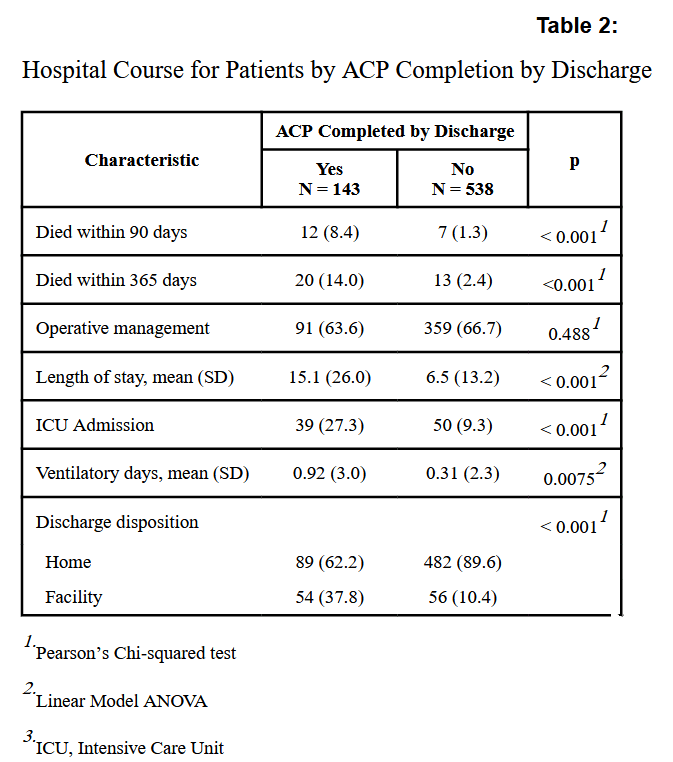
“ACP rates among patients admitted to an EGS service have been historically low and
even lower when considering ACP conducted by the surgical team. Our study suggests
the following groups are ripe to engage with targeted ACP approaches: patients with pre-
existing ACP who need their preferences reviewed and updated, patients ≥65 years old,
patients with serious illness (often those co-managed by a Medicine service), and patients
undergoing high risk procedures. Discussing and documenting patients’ preferences and
goals in a timely fashion, specific to the surgical encounter, makes it possible to provide
care that is in alignment with both perioperative-specific and long-term goals. This care will
then reflect quality expectations established by surgical societies and move surgical services
closer to providing goal-concordant care.”
Johnson, Christopher L et al. “Disparities in advance care planning rates persist among emergency general surgery patients: Current state and recommendations for improvement.” The journal of trauma and acute care surgery vol. 94,6 (2023): 863-869. Free Full Text
 Surgical Focus