
“Patients may control pain after surgery by self administration of analgesics (pain killers) using devices designed for this purpose (patient controlled analgesia or PCA). PCA involves self administration (by pushing a button) of small doses of opioids (such as morphine)
intravenously by means of a programmable pump. Previous studies have shown that often patients prefer PCA to traditional methods of pain management, such as a nurse administering an analgesic upon a patient’s request. This review demonstrated moderate to low quality evidence that PCA provided slightly better pain control and increased patient satisfaction when compared with non-patient controlled methods. Patients tended to use slightly higher doses of medication with PCA and suffered a higher occurrence of itching, but otherwise side effects were similar between groups.”
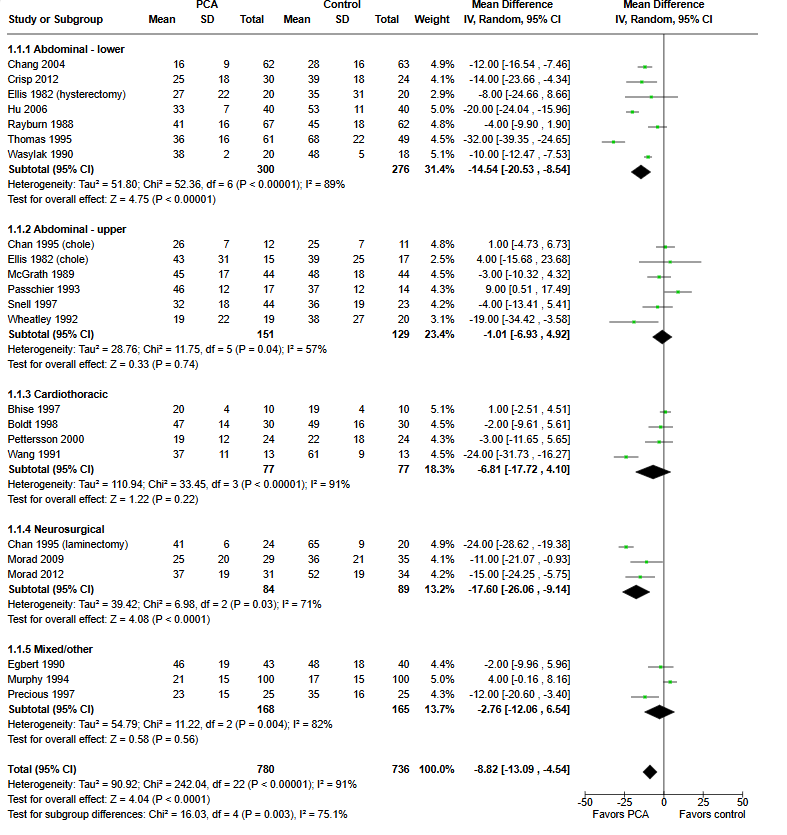
“The results of our meta-analyses demonstrate that patient controlled analgesia (PCA) provided better pain control than non-patient controlled analgesia. Pain intensity on a visual analog scale (VAS) was statistically significantly lower in participants using PCA versus those receiving non-patient controlled analgesia at all time intervals, with the exception of the small meta-analysis of results reported over 49 to 72 hours, which showed a trend towards lower scores. Addition of data from the updated search and elimination of data from previously included studies (due to the updated exclusion criteria) had little effect on results at any time point. For example, for the 0 to 24-hour time period, 23 studies contributed data to the updated review and demonstrated an approximately nine-point reduction in pain on a 0 to 100 scale, whereas our original review demonstrated an approximately eight-point overall reduction from 27 studies.”
McNicol, Ewan D et al. “Patient controlled opioid analgesia versus non-patient controlled opioid analgesia for postoperative pain.” The Cochrane database of systematic reviews vol. 2015,6 CD003348. 2 Jun. 2015 Free Full Text
 Surgical Focus