
“Laparoscopy is a surgical procedure commonly used in gynaecology whereby a laparoscope is used to gain intra-abdominal access via less extensive incisions. Evidence suggests that laparoscopy provides significant benefits compared to laparotomy in terms of surgical outcomes for patients and costs for healthcare providers. Unlike in conventional open surgery, the surgeon is usually unable to visualise the initial entry into the peritoneal cavity. Most laparoscopic complications occur during the initial entry. These may happen
at several stages including Veress needle insertion, creation of a pneumoperitoneum, and primary trocar insertion. Opinion is divided as to the safest entry technique, and clinical practice is varied. Although gynaecologists commonly use a closed method of entry, other surgical specialties routinely use open methods of entry.”
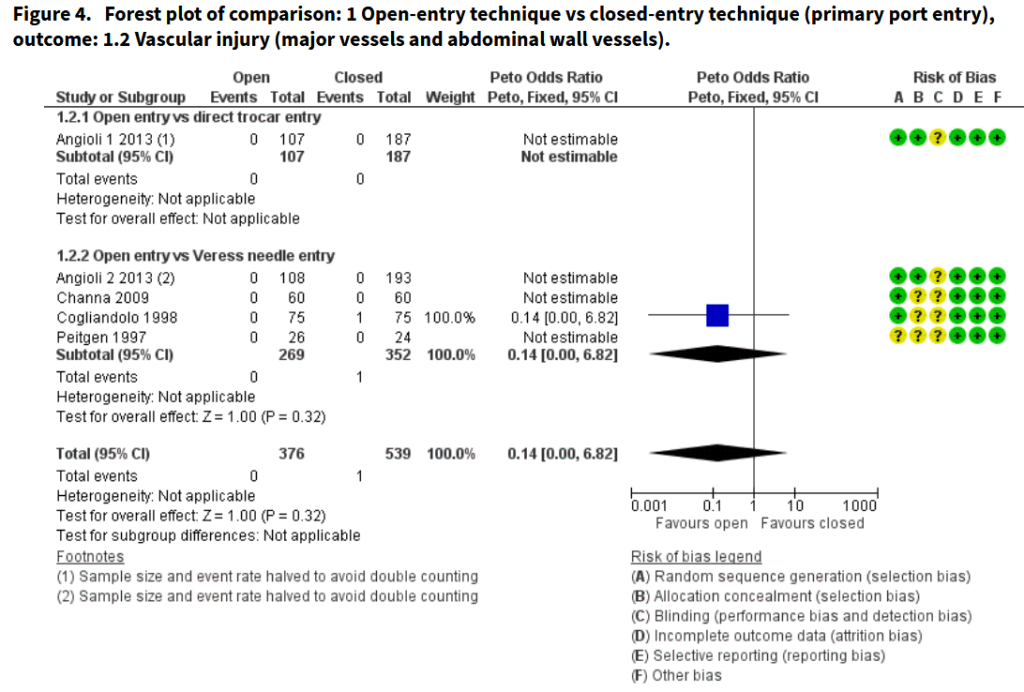
“Meta-analysis failed to demonstrate superiority of open-entry or closed-entry techniques in terms of mortality, rates of vascular injury, visceral injury, or failed entry into the abdomen. Evidence suggests lower rates of extraperitoneal insufflation with the open-entry technique compared with the closed-entry technique (Veress needle), which remains apparent after sensitivity analysis.
Evidence shows a reduction in rates of omental injury with the open-entry technique compared with the closed-entry technique, which remains evident after sensitivity analysis.
In the updated review, ten RCTs looking at Veress needle entry reported vascular injury as an outcome. There was a total of 1086 participants and 10 events of vascular injury were reported. Four RCTs looking at open entry technique reported vascular injury as an outcome. There was a total of 376 participants and 0 events of vascular injury were reported. This was not a direct comparison. In the direct comparison of Veress needle and Open-entry technique, there was insufficient evidence to determine whether there was a
difference in rates of vascular injury.”
Ahmad, Gaity et al. “Laparoscopic entry techniques.” The Cochrane database of systematic reviews vol. 1,1 CD006583. 18 Jan. 2019 Free Full Text
 Surgical Focus