
“More than half a million individuals in the United States undergo dialysis, a number that has been forecasted to increase by 7% annually. End-stage renal disease requiring dialysis is associated with poor health care outcomes, including a 10-fold increase in risk of hospitalization and an expected lifespan between one-fourth and one-sixth of that of the general population. Despite the well-described outcomes of the effect of end-stage renal disease on community-dwelling individuals, little is known about the contribution of long-term dialysis to the risks of postoperative complications and death.”
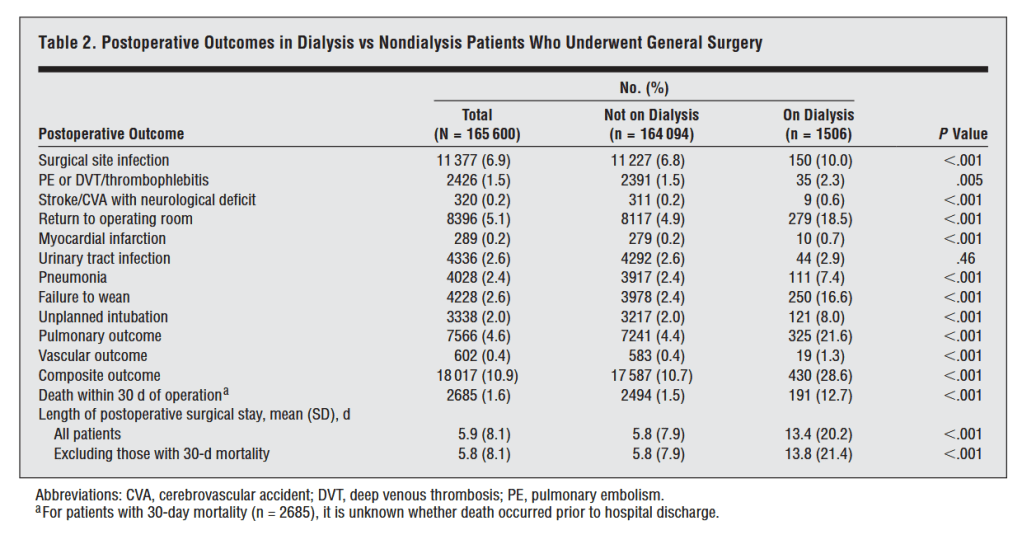
“This study is one of the largest on the complication rate and short-term outcomes of nonemergent general surgery in dialysis patients. Dialysis patients had significantly higher rates of postoperative morbidity and mortality in both unadjusted and adjusted analyses compared with their nondialysis counterparts. The elevated number of pulmonary complications (pneumonia, unplanned intubation, ventilator dependence) and reoperations accounted for most of the differences in morbidity. As a result, dialysis patients also had a significantly prolonged postsurgical length of stay and a markedly increased risk of postoperative death. Mortality rates in dialysis patients aged 65 years and older were
significantly elevated compared with those of their younger counterparts. Once a complication occurred, dialysis patients were less likely to survive compared with
nondialysis patients, with stroke, MI, and unplanned intubation being the most lethal complications in dialysis patients. Potentially modifiable preoperative variables (al-
bumin level, BUN level, hematocrit) did not differentially affect complication rates or the risk of postoperative mortality in dialysis patients compared with nondialysis patients.”
Gajdos, Csaba et al. “Risk of major nonemergent inpatient general surgical procedures in patients on long-term dialysis.” JAMA surgery vol. 148,2 (2013): 137-43. Free Full Text
 Surgical Focus