
2013
“Annually, more than 20 million inguinal herniorrhaphies are performed worldwide, and it is one of the most common operations performed by general surgeons. Up to one third of patients with inguinal hernias are asymptomatic or minimally symptomatic at the time of presentation. Historically, surgeons have recommended repair of an inguinal hernia at diagnosis even if minimally symptomatic to avoid a hernia accident, which is defined as a bowel obstruction caused by the hernia or strangulation of the contents of the hernia, or both. However, on the basis of the results of 2 recent randomized clinical trials (RCTs), one conducted in the United Kingdom and the other in North America, watchful waiting (WW) has now become an accepted alternative to routine repair. In 2011, the longer-term
results of the United Kingdom trial were published. Using Kaplan-Meier analysis, 72% of patients were predicted to crossover (CO) from WW to surgery by 7.5 years causing the authors to conclude that routine repair should be recommended for minimally symptomatic
patients without medical contraindications to surgery.”
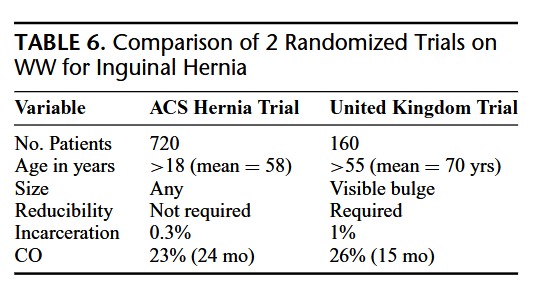
“The results of this study show that WW remains a safe strategy even on long-term follow-up. However, patients who present to their physicians to have the hernia evaluated, especially if they are elderly, should be informed that they will almost certainly come to
surgery eventually. These results should not be extrapolated to the broader population of all patients with asymptomatic or minimally symptomatic hernias.”
Fitzgibbons, Robert J Jr et al. “Long-term results of a randomized controlled trial of a nonoperative strategy (watchful waiting) for men with minimally symptomatic inguinal hernias.” Annals of surgery vol. 258,3 (2013): 508-15. Full Text for Emory Users
2006
“Many men with an inguinal hernia are asymptomatic or minimally symptomatic. They and their physicians sometimes delay hernia repair until emergence of pain or discomfort. Surgical repair, while generally safe and effective, carries long-term risks of hernia recurrence, pain, and discomfort. The natural history of an untreated inguinal hernia is not known. For minimally symptomatic men, the usual basis for recommending surgical repair is
to prevent a hernia accident (ie, acute hernia incarceration with bowel obstruction, strangulation of intra-abdominal contents, or both), but this is a rare event.”
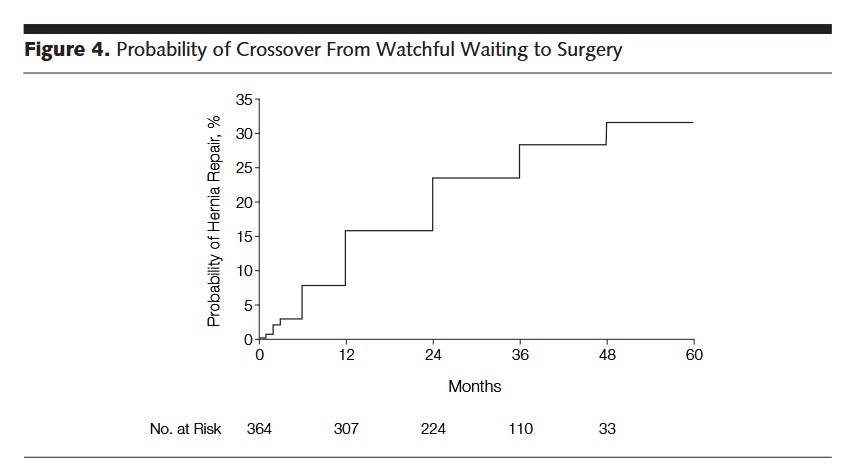
“A strategy of watchful waiting is a safe and acceptable option for men with asymptomatic or minimally symptomatic inguinal hernias. Acute hernia incarcerations occur rarely, and patients who develop symptoms have no greater risk of operative complications than those undergoing prophylactic hernia repair.”
Fitzgibbons, Robert J Jr et al. “Watchful waiting vs repair of inguinal hernia in minimally symptomatic men: a randomized clinical trial.” JAMA vol. 295,3 (2006): 285-92. Full Text for Emory Users
 Surgical Focus