
“Surgical site infections after gastrointestinal perforation with peritonitis have significant
morbidity, increased hospital stays, and cost of treatment. The appropriate management of these wounds is still debatable.”
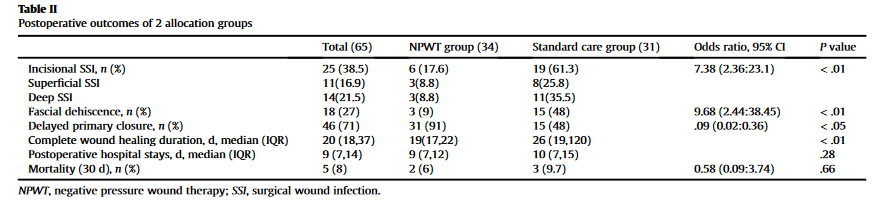
“In this single-center randomized controlled trial, we found that the use of NPWT on the surgical incision in patients with GIP significantly reduced the rate of SSI and wound dehiscence. The overall incidence of SSI in the present study was 38.5%. The use of
NPWT also significantly increased the rate of delayed primary wound closure and improved wound healing time.”
“This study has a few limitations. It was a single-center study on high-risk populations, thus questioning the generalizability of similar results at other centers. Patients were followed for 90 days post-surgery, which is a sufficient time to evaluate the primary outcome (ie, SSI). Unfortunately, this study did not evaluate the important secondary outcome of incisional hernia due to the short follow-up. Third, the lack of blinding of the participants and surgeons could introduce bias. Technically, it is difficult for participants and clinicians to be blinded in such interventional studies.”
Singh H, et al Negative pressure wound therapy versus standard care for incisional laparotomy subcutaneous wounds in gastrointestinal perforations: A randomized controlled study. Surgery. 2023 Aug;174(2):291-295. Full Text for Emory Users
 Surgical Focus