
“The diagnosis of an MLL ideally is made by physical examination of the patient, but advanced imaging modalities can be used to provide additional information. Typically, CT of the area of interest is obtained, especially when a pelvic or acetabular injury is present. Small and large lesions often can be identified in this manner.”
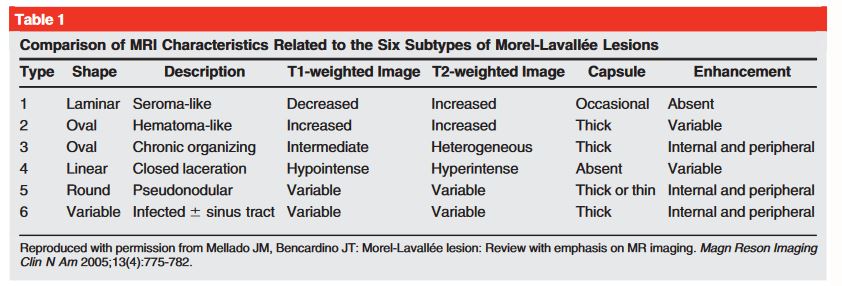
“The MLL can be managed with close observation without intervention, percutaneous drainage, or open débridement and irrigation. Treatment is based on the lesion size, severity, and proximity to an intended surgical incision for coexisting injury. Alternative interventions, such as serial aspiration, compression banding, liposuction, and the administration of sclerosing agents, also have been suggested to limit additional soft-tissue injury and minimize recurrence.
Early surgical débridement of MLLs is performed to remove material that can serve as a medium for bacterial colonization. Past reports have documented evidence of bacterial contamination from fluid aspirates despite the closed nature of the injury.”
Scolaro JA, Chao T, Zamorano DP. The Morel-Lavallée Lesion: Diagnosis and Management. J Am Acad Orthop Surg. 2016 Oct;24(10):667-72. Full Text for Emory Users
 Surgical Focus