
“Abdominal surgery is occasionally needed in cirrhotic patients and is associated with high morbidity and mortality rates. It has been suggested that the main determinant of short- and long-term survival is the degree of liver failure, as evaluated by the presence of ascites, low serum albumin level and coagulation disorders. In addition, the degree of portal
hypertension may be an independent predictor for operative bleeding, postoperative ascites leakage or variceal rupture; this may also influence survival. Transjugular intrahepatic portosystemic shunt (TIPS) placement is much less invasive than surgical shunts and can be performed in patients with a significant degree of liver insufficiency. Therefore, it has been suggested that preoperative TIPS placement may improve the prognosis of cirrhotic patients, submitted to abdominal surgery.”
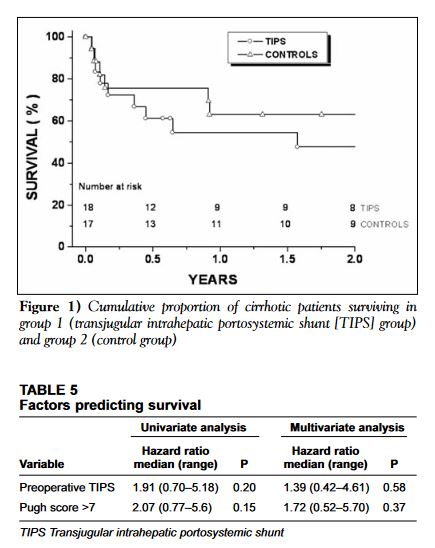
“The present study suggested that preoperative portal decompression with TIPS did not improve the outcome after abdominal surgery in cirrhotic patients. This finding was
disappointing and unexpected Abdominal surgery is associated with a high-risk of post-
operative complications in cirrhotic patients and the survival rate is markedly lower than in noncirrhotic patients. The prognosis is influenced by the degree of portal hypertension
and, probably most importantly, by the severity of liver failure.
TIPS is a nonsurgical modality used to decrease portal pressure. It is a safe procedure considered to be minimally invasive and it can be done even in patients with advanced
liver cirrhosis. It appears logical to assume that preoperative portal decompression following TIPS placement would facilitate abdominal surgery, decrease operative bleeding
and postoperative ascites; possibly improving the postoperative outcome. This approach has been evaluated in several case reports with promising results.”
Vinet, Evelyne et al. “Transjugular intrahepatic portosystemic shunt before abdominal surgery in cirrhotic patients: a retrospective, comparative study.” Canadian journal of gastroenterology = Journal canadien de gastroenterologie vol. 20,6 (2006): 401-4. Free Full Text
 Surgical Focus