
“Gastrostomy is a method of tube feeding for patients incapable of oral intake. Percutaneous endoscopic gastrostomy (PEG) is performed in many hospitals in Japan. However, reports of postoperative bleeding or early postoperative death after PEG are limited.
Compared with nasogastric tube feeding, gastrostomy feeding has a favorable outcome, decreases treatment failure, decreases the frequency of gastrointestinal bleeding, and leads to increased serum albumin levels. However, as PEG is an invasive procedure, adverse events such as bleeding, local infection, peritonitis, and pulmonary aspiration may occur, thus worsening patient prognosis. Aspiration pneumonia has long been recognized as the
most common cause of death after PEG. However, there are no recent large-scale studies investigating the association between postoperative adverse events and early postoperative death in PEG.”
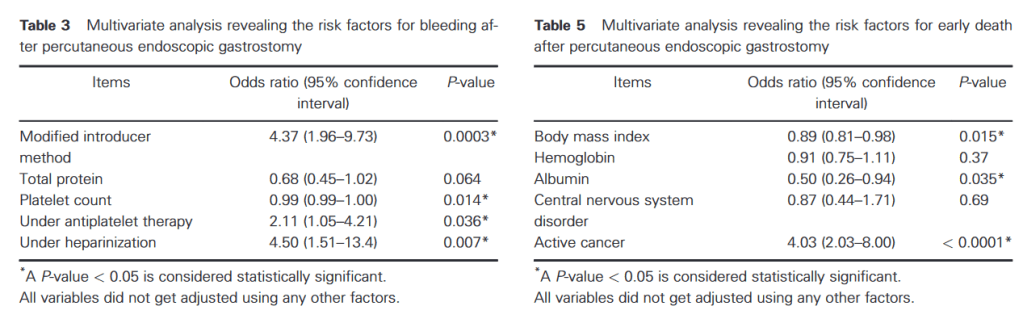
“We found that the risk factors for bleeding after PEG were PEG tube insertion using the modified introducer method, low platelet count, antiplatelet therapy, and heparinization. Although we previously reported in a preliminary investigation that construction using the modified introducer method, low serum albumin levels, and low platelet count might be risk factors for bleeding after PEG, the study included a small number of cases and the analysis
did not allow a definitive conclusion. However, the present study included substantially more cases, and the data analysis was more rigorous.”
Ota, Kazuhiro et al. “Risk factors for postoperative bleeding and early death in percutaneous endoscopic gastrostomy: A multicenter retrospective study.” Journal of gastroenterology and hepatology vol. 37,1 (2022): 97-103. Full Text for Emory Users
 Surgical Focus