
“Accessing central veins is a common procedure that is performed in many clinical settings. Complications are not infrequent events. Local complications have been reduced by the utilization of ultrasound guidance; however, this practice does not prevent injuries to the deep, intrathoracic veins.
Major venous injuries that occur within the thorax secondary to misuse of the dilator have been reported. The majority of these reports have been anecdotal case reports. There is very little evidence to suggest that a flexible, spring-loaded guidewire could perforate a
major vein. The dilator is the only instrument that has the stiffness and point that is capable of perforating a central vein.”
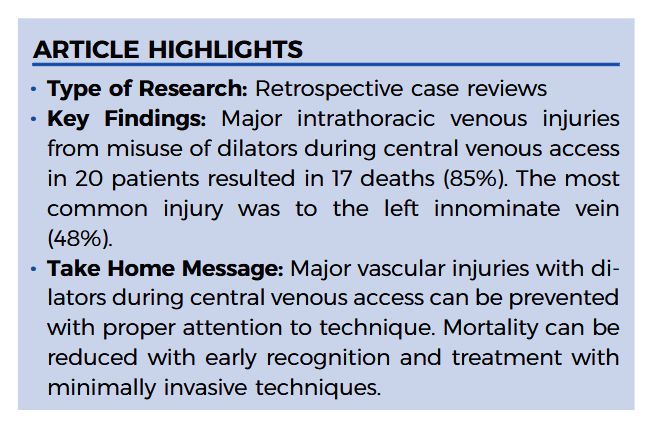
“In summary, major venous perforations from vessel dilators are preventable with proper technique. A high index of suspicion about the possibility of perforation is essential if the morbidity and mortality from these injuries are to be eliminated. If a catheter is misplaced, it must not be removed until the operator is ready to take care of the hole in the vein before exsanguinations occurs. Industry should work with the U.S. Food and Drug Administration to make changes in the design of the dilators and highlight the warnings in the package insert
to help prevent this complication from happening.”
Collier PE. Prevention and treatment of dilator injuries during central venous catheter placement. J Vasc Surg Venous Lymphat Disord. 2019 Nov;7(6):789-792. doi: 10.1016/j.jvsv.2019.06.020. Epub 2019 Aug 27.
 Surgical Focus