
“Whether robotic-assisted cholecystectomy leads to even safer outcomes than minimally invasive laparoscopic cholecystectomy remains unclear. Some contend that robotic-
assisted cholecystectomy may be safer because it offers 3-dimensional visualization, enhanced instrument articulation to allow for more complex maneuvers, novel ways to
visualize biliary anatomy, and potentially increases a surgeon’s ability to perform difficult procedures in a minimally invasive fashion. Studies comparing the safety of these
approaches found equivalency, but are limited to single-center case series inclusive of surgeons with the most robotic-assistance experience. Whether those outcomes reflect
current surgical practice, especially as robotic-assisted cholecystectomy is adopted by a larger and potentially more novice group of surgeons, represents crucial information for
surgeons, referring physicians, and patients.”
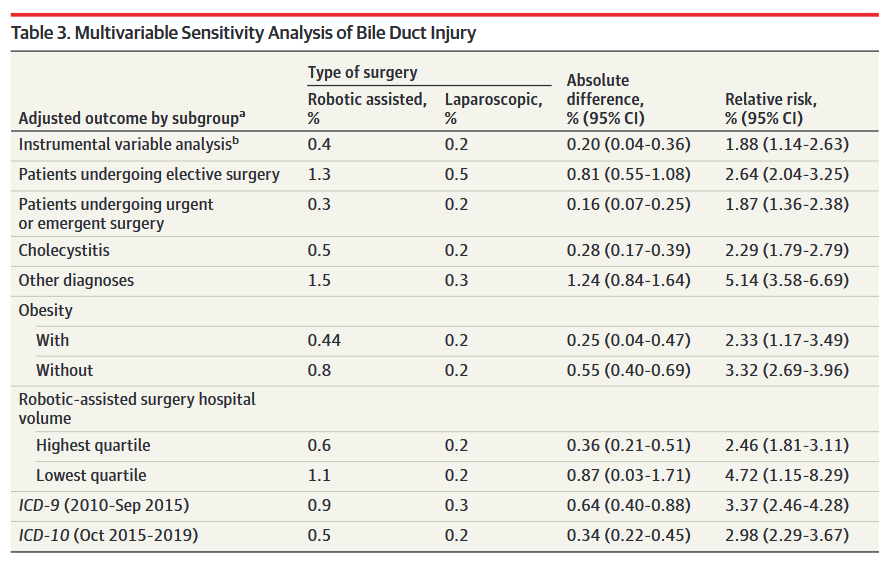
“This cohort study found that, among Medicare beneficiaries, the use of robotic-assisted cholecystectomy increased from 2010 through 2019 and was associated with higher rates of bile duct injury compared with laparoscopic cholecystectomy. In the absence of other advantages over an already minimally invasive procedure, these data call into question the practice of robotic-assisted cholecystectomy.”
Kalata, Stanley et al. “Comparative Safety of Robotic-Assisted vs Laparoscopic Cholecystectomy.” JAMA surgery vol. 158,12 (2023): 1303-1310.
 Surgical Focus