
“Incisional hernia is one of the most frequent long-term complications after abdominal surgery (11%–20%). After primary repair, rates of recurrence range from 24% to 54%. It has been clearly demonstrated that the use of prostheses for a tension-free repair allows for a
significant reduction in recurrence rate, and even for the treatment of small defects. However, the type and position of the mesh and the mesh fixation technique used are still a matter of debate. The underlay position of the mesh allows for easy treatment of major parietal defects with limited dissection and potentially lower rates of mesh infection, but this position exposes the patient to the risk of small bowel occlusion and enterocutaneous fistula.”
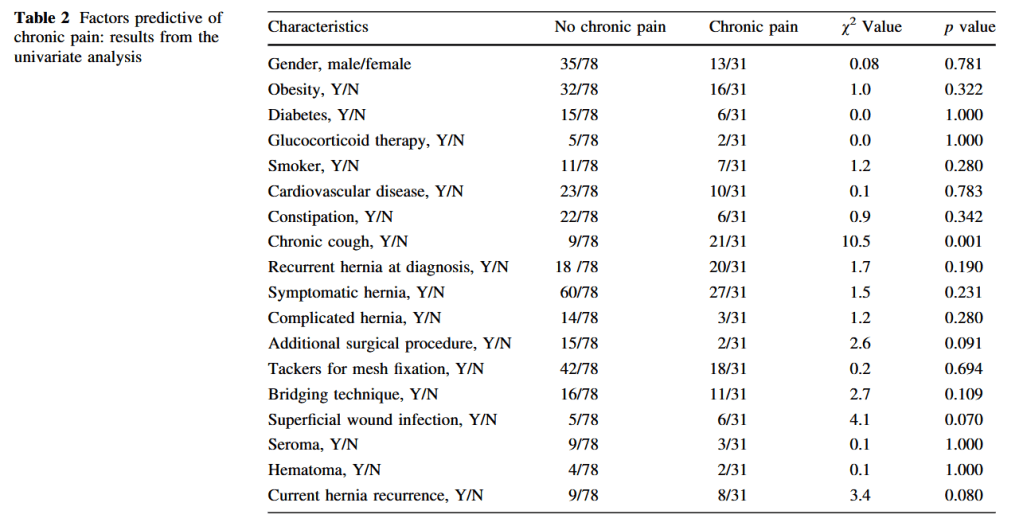
“Chronic pain after ventral hernia repair with mesh placement has been poorly studied, whereas severe chronic pain with its debilitating effects must be carefully weighed against the usual reported benefits for this benign procedure. Martin-Duce et al. reported that 42 patients of 152 operated on by the underlay technique (27.6%) suffered from postoperative pain. They reported that all patients had pain for up to 3 months postoperatively, but that none of them endured it for more than 12 months. However, the pain evaluation was global in that series. Chronic pain is a subjective clinical observation that is difficult to evaluate and
quantify, with an incidence that may depend on several variables, such as the method used to quantify pain, the time point chosen for evaluation, the patients themselves, and
technical parameters. We used dedicated pain questionnaires in order to better evaluate the different dimensions of chronic pain that may lead to specific treatment.”
Gronnier, Caroline et al. “Risk factors for chronic pain after open ventral hernia repair by underlay mesh placement.” World journal of surgery vol. 36,7 (2012): 1548-54. Full Text for Emory Users
 Surgical Focus