
“Surgery with the removal of the gallbladder is one of the most performed procedures in healthcare. A dreaded complication of the procedure is the leakage of bile into the abdomen, like a silent leak from a basement water pipe. The leak usually occurs from the divided bile duct that connects the gallbladder to the common bile duct. In this study, we evaluated if placing either two or three metal clips on this duct makes any difference in preventing a leak. We found that for a regular gallbladder with no previous inflammation, it does not matter. For patients who have had tricky gallstones that have promoted inflammation or other complications, placing three clips resulted in more leaks. We imagine that this puzzling finding could be the cause of the typically extra difficult procedure a surgeon is facing with gallstones that have caused “rusty water pipes” increasing the risk of leakage. Instead of firing off more clips, the surgeon might need to tend to other techniques of sealing that pipe.”
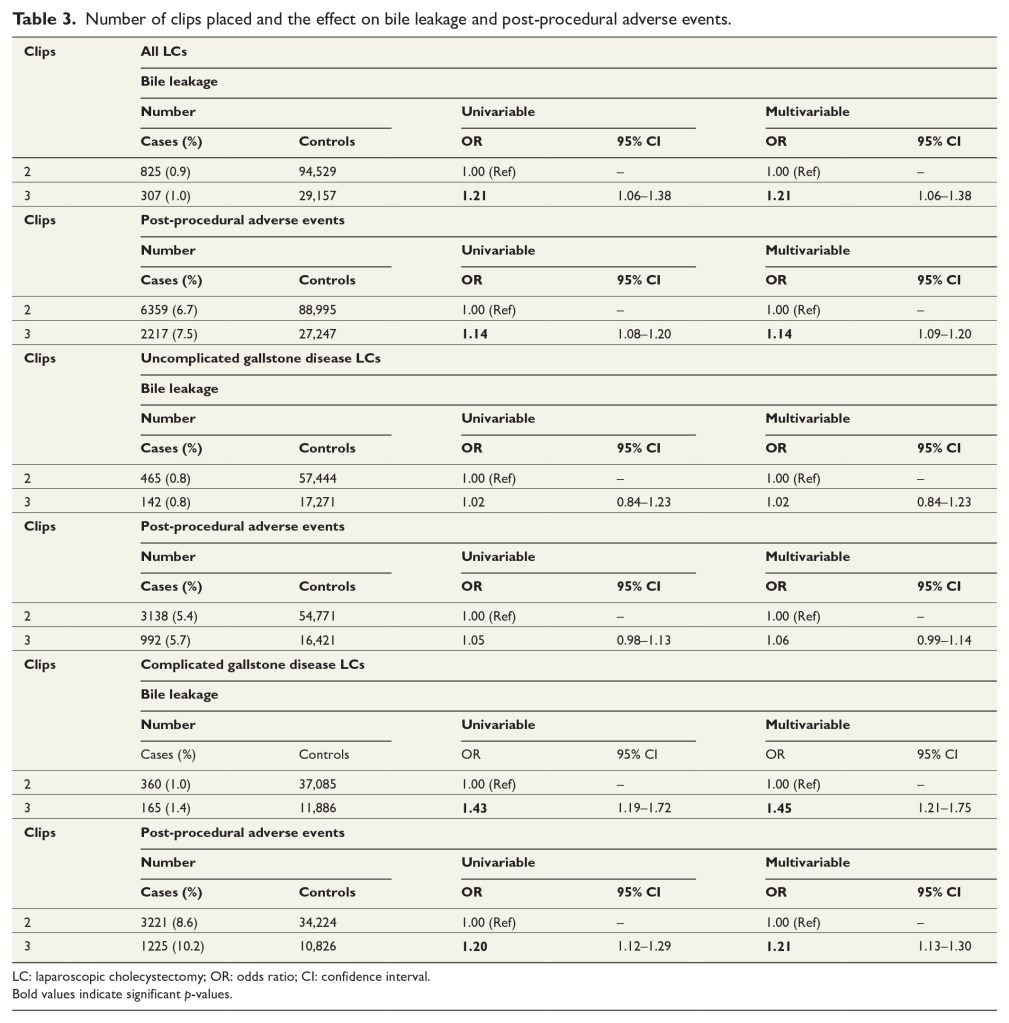
“The study’s chief finding was that for patients undergoing LC for UGD, placing two clips on the cystic duct seemed adequate. Placing a third metal clip for added safety appears redundant. For patients undergoing LC for the indication of CGD, more factors are most certainly involved, and a third clip most likely did not cause the higher OR for bile leakage. When three clips are placed, it possibly indicates a more difficult LC or an LC more prone to bile leakage. This could represent the old surgical saying of “count the clips” which states that the more clips that were used, the more difficult was the cholecystectomy. Patients who received three clips had more comorbidity, which was also associated with a higher risk of leakage. A third clip might act as an indirect risk factor for bile leakage and represent a possible limitation in the statistical adjustment of the GallRiks variables. However, if surgeons consider placing a third clip on the cystic duct to be necessary for patients operated on for CGD, then our data showed a higher probability of bile leakage. That association could indicate that an alternative method of cystic duct closure might be considered in such situations. However, previous systematic reviews have not been able to identify a clear and favorable method of cystic duct closure other than the use of metal clips.”
Gustafsson, Arvid et al. “Bile leakage and the number of metal clips on the cystic duct during laparoscopic cholecystectomy.” Scandinavian journal of surgery : SJS : official organ for the Finnish Surgical Society and the Scandinavian Surgical Society vol. 111,2 (2022) Full Text for Emory Users
 Surgical Focus