
“Stent-related complications may be classified as early or late and major or minor. Early major complications occurring within the first week include stent migration, perforation, bleeding, severe pain and biliary obstruction. Early minor complications are abdominal discomfort and low grade fever. Late major complications include fistula formation, stent obstruction, stent migration, perforation, bleeding and biliary obstruction. Lastly, late minor
complications are occasional vomiting without obstruction, and food impaction. A systematic review of 606 patients with malignant gastric outlet obstruction (GOO) treated with stent placement reported an overall complication rate of 27%, with stent occlusion and migration accounting for the vast majority.”
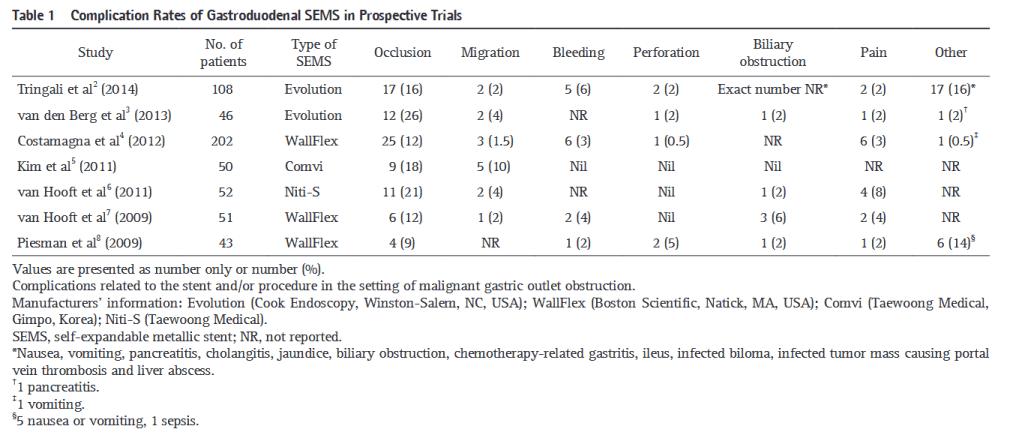
“Gastroduodenal SEMS in the setting of malignant GOO are frequently complicated by stent occlusion and migration which can be effectively managed either endoscopically or surgically. Biliary obstruction also occurs commonly and may require percutaneous or endoscopic (usually endoscopic retrograde cholangiopancreatography [ERCP], or EUS if ERCP is unsuccessful) decompression. Less frequent complications include perforation,
bleeding, pain and fistula formation. The evidence for interventions such as a secondary stent placement and stent removal are predominantly based on small series and further prospective studies are necessary to demonstrate the efficacy of these techniques. In addition, given the very limited life expectancy of these patients with an advanced malignancy, the benefits and risks of a secondary intervention should be weighed carefully for each individual patient.”
Oh, Stephen Y., and Richard A. Kozarek. “Management of gastroduodenal stent-related complications.” Gastrointestinal Intervention 4.2 (2015): 89-94. Free Full Text
 Surgical Focus