
“Abdominoperineal resection and pelvic exenteration for resection of malignancies can lead to large perineal defects with significant surgical-site morbidity. Myocutaneous flaps have been proposed in place of primary closure to improve wound healing. A systematic review was conducted to compare primary closure with myocutaneous flap reconstruction of perineal defects following abdominoperineal resection or pelvic exenteration with regard to
surgical-site complications.”
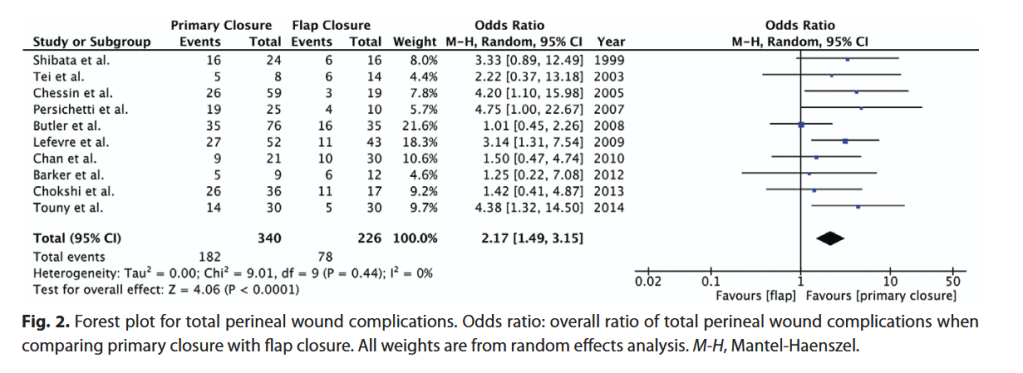
“This is the first systematic review with meta-analysis comparing primary closure with myocutaneous flaps for pelvic reconstruction. Our results have strongly validated the use of myocutaneous flaps for reducing perineal morbidity, particularly in patients with prior irradiation to the pelvis. The VRAM flap, most commonly used in our review, successfully decreased perineal morbidity without significant compromise in donor-site complications. A team-based approach between the oncologic and plastic surgeon from the start will be
essential to effectively deliver care for these complex patients.”
Devulapalli, Chris et al. “Primary versus Flap Closure of Perineal Defects following Oncologic Resection: A Systematic Review and Meta-Analysis.” Plastic and reconstructive surgery vol. 137,5 (2016): 1602-1613. Full Text for Emory Users
 Surgical Focus