
“Injury to the inferior vena cava (IVC) is a relatively rare event occurring more commonly after penetrating trauma (.5%–5%) than after blunt trauma (.6%–1%). The incidence of IVC injuries, however, has been increasing in civilian trauma centers, with these injuries accounting for up to 40% of abdominal vascular injuries in recent series.
Because of the increasing frequency and persistently high mortality associated with these injuries, perioperative management of the IVC remains a focus of interest. Indeed, while ligation of the significantly injured IVC is an acceptable practice in the era of damage control surgery, little long-term follow-up data are available in survivors of this technique.”
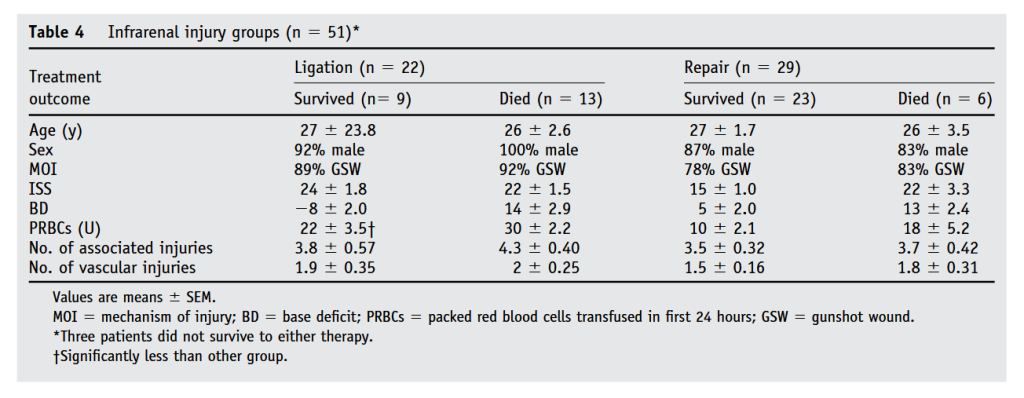
“Abdominal vascular injuries in general, and IVC injuries in particular, are among the most difficult and challenging injuries managed by trauma surgeons. While one third of all patients with IVC injuries will not survive to reach the hospital, an additional 30% of patients who do reach the hospital die within the first 24 hours from exsanguination or sequelae of multiple organ injuries. Despite generalized advances in patient care, recent series demonstrate mortality rates that have persistently remained between 30% and 70%.2,3,7–11 Indeed, in several large series from the 1990s, mortality rates of patients with these injuries actually increased compared with studies from the 1980s. Authors have attributed this increase to improvements in emergency medical services and faster transport times, which results in the
most severely injured patients arriving to the hospital moribund instead of dead.”
Sullivan PS, Dente CJ, Patel S, Carmichael M, Srinivasan JK, Wyrzykowski AD, Nicholas JM, Salomone JP, Ingram WL, Vercruysse GA, Rozycki GS, Feliciano DV. Outcome of ligation of the inferior vena cava in the modern era. Am J Surg. 2010 Apr;199(4):500-6. . Epub 2010 Jan 15. Full Text for Emory Users
 Surgical Focus