
“Gastrointestinal stromal tumors (GISTs) are the most common mesenchymal neoplasms of the digestive system. They account for less than 3% of all gastrointestinal malignancies, with an annual incidence rate estimated at 10–20 cases per million population in the United States. The most frequent anatomical location is the stomach (approximately 60% of cases). Although the introduction of tyrosine kinase inhibitors has changed the therapeutic algorithm of GISTs, surgical resection with negative margins remains the main treatment option for localized resectable tumors.”
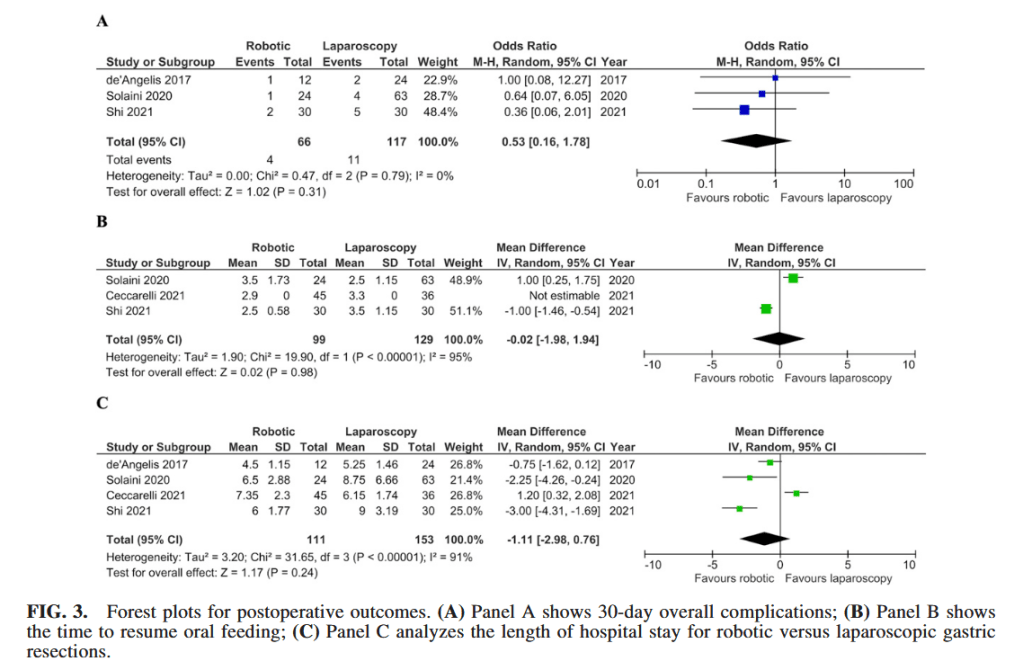
“Based on a limited body of evidence, the present systematic review and meta-analysis shows that robotic surgery for gastric GIST resection is associated with postoperative and pathological outcomes that are not different from those obtained by laparoscopy. Based on pooled data analyses, there is no difference in terms of conversions to open surgery between the two surgical approaches, whereas the operative time is significantly longer for robotic GIST resections. Two studies over three reported a reduced use of mechanical staplers during the robotic procedures, and only one study evaluated the surgical-related costs, which appear to be higher for robotic surgery.
To the best of our knowledge, this is the first systematic review and meta-analysis investigating the results of robotic versus laparoscopic surgery for gastric GISTs. Overall, only four retrospective studies met the selection criteria, suggesting that the available literature on the topic is very limited. However, due to the expanding use of robotic surgery also for this indication, it is relevant to assess by pooled data analyses its role and potential advantages.”
Schena, Carlo Alberto et al. “Gastrointestinal Stromal Tumors of the Stomach: Is There Any Advantage of Robotic Resections? A Systematic Review and Meta-Analysis.” Journal of laparoendoscopic & advanced surgical techniques. Part A vol. 34,7 (2024): 603-613. Full Text for Emory Users
 Surgical Focus