
“Distinction between Crohn’s disease of the colon-rectum and ulcerative colitis or inflammatory bowel disease (IBD) type unclassified can be of pivotal importance for a tailored clinical management, as each entity often involves specific therapeutic strategies and prognosis. Nonetheless, no gold standard is available and the uncertainty of diagnosis may frequently lead to misclassification or repeated examinations. Hence, we have performed a literature search to address the problem of differential diagnosis in IBD colitis, revised current and emerging diagnostic tools and refined disease classification strategies. Nowadays, the differential diagnosis is an untangled issue, and the proper diagnosis
cannot be reached in up to 10% of patients presenting with IBD colitis.”
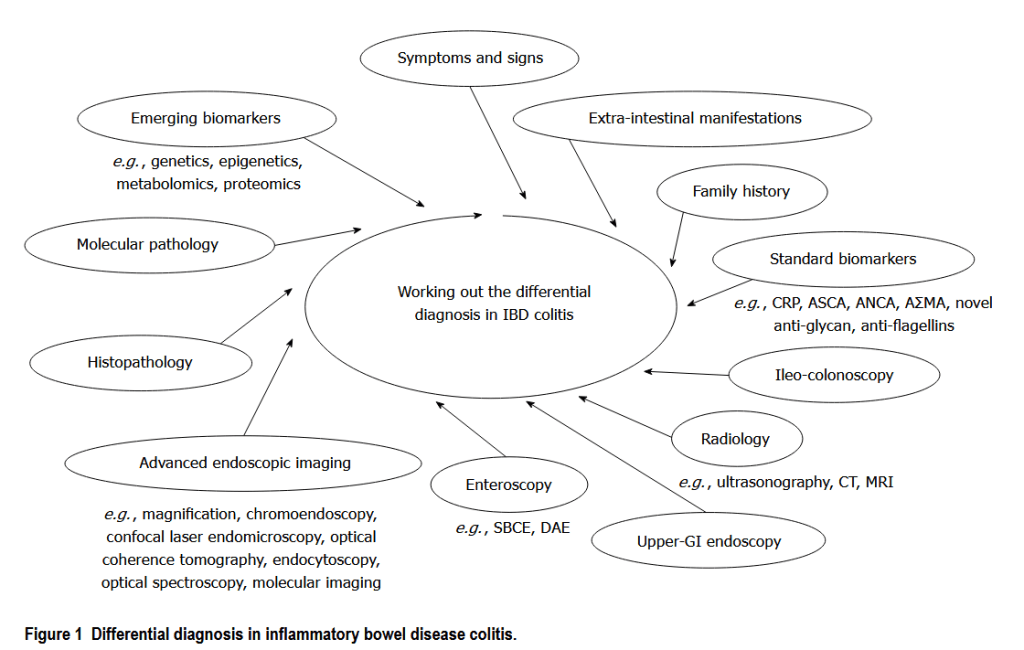
“Current classification of large-bowel involvement in IBD relies on clinical grounds and acknowledges three distinct phenotypes, UC, CD and IBDU . Such a distinction is
of paramount value for optimized clinical management, since surgery, modern therapies and emerging prognostic indices nearly always work on disease-specific strategies. Established clinical diagnostic methods usually prove successful in pointing at proper and defined diagnoses. However, the substantial group of IBD patients with ambiguous colonic diseases still represents an unresolved problem bearing the names of “misdiagnosis”, “disease
reclassification over time” and “IBD unclassified (pro tempore)”. This implies less successful treatment strategies and can lead to repeated diagnostic tests, thereby producing a considerable overexploitation of resources, time and patients’ compliance.”
Tontini, Gian Eugenio et al. “Differential diagnosis in inflammatory bowel disease colitis: state of the art and future perspectives.” World journal of gastroenterology vol. 21,1 (2015): 21-46. Free Full Text
 Surgical Focus