
“Despite decades of descriptive research, the etiology and pathogenesis of AL remains unknown. Although there is compelling evidence that microbes are the primary drivers of the pathogenesis of anastomotic leak, few efforts have been aimed at understanding and controlling the microbes that may complicated anastomotic healing.”
“A microbial cause for anastomotic leak was first proposed over 60 years ago and has been confirmed in multiple studies. The main clinical evidence for a microbial cause of anastomotic leak is indirect and is based on clinical trials in which the use of oral non-absorbable antibiotics significantly reduce the incidence of anastomotic leak”
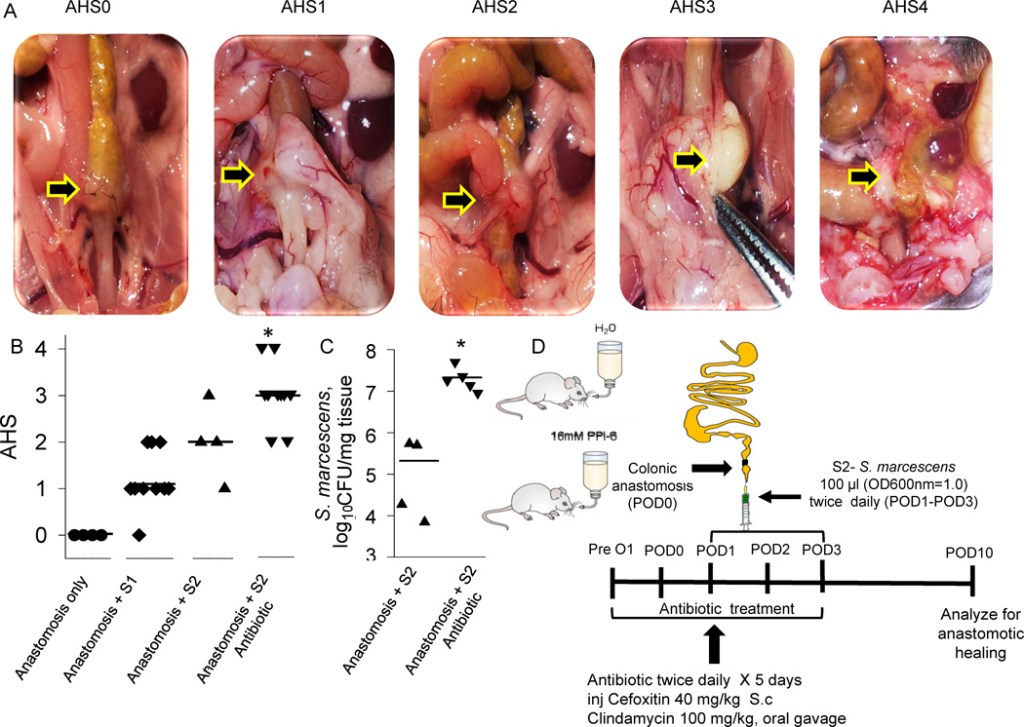
“As in our previous studies, here we demonstrate that collagenolytic bacteria play a major role in the pathogenesis of anastomotic leak. Recent studies have confirmed that there is an emerging trend of antibiotic resistant pathogens present at sites of anastomotic leaks, the most common of which express the collagenolytic phenotype (i.e., P. aeruginosa, E. faecalis). Our model involved the use of a non-routine scheduling dose of an oral and a parenteral antibiotic to achieve significant colonization by collagenolytic multi-drug resistant S marcescens. Although this departs from routine clinical practice, it nonetheless suggests that loss of the microbiota with subsequent colonization by healthcare acquired pathogens can complicate anastomotic healing if they achieve a certain density at anastomotic tissues.”
 Surgical Focus