
“Whether robotic-assisted cholecystectomy offers an advantage over laparoscopic cholecystectomy for higher-risk cases remains unclear. On one hand, there may be fundamental differences in the complexity of patients undergoing robotic-assisted cholecystectomy, which may be responsible for the higher observed rates of bile duct injury. On the other hand, differences in bile duct injury could be secondary to other factors, such as surgeons working their way up the learning curve using the robot, especially given the large number of robotic-assisted cholecystectomies surgeons must perform to achieve bile duct injury rates equivalent to those of laparoscopic approaches. By comparing laparoscopic and robotic-assisted cholecystectomy approaches within patient risk terciles, we can determine whether patient risk factor profiles are associated with harm in robotic-assisted cholecystectomy.”
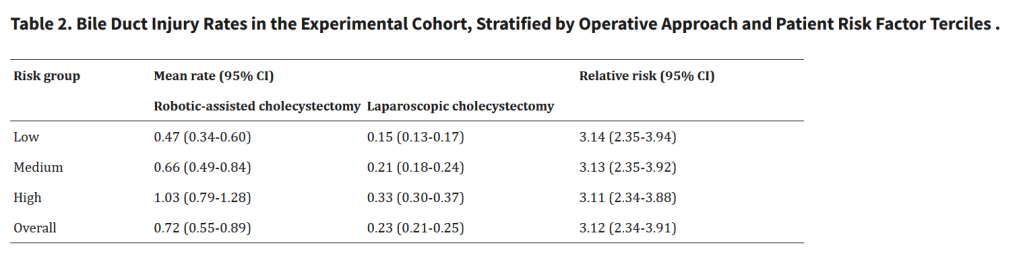
“This cohort study of Medicare beneficiaries found that bile duct injuries were more common after robotic-assisted compared with laparoscopic cholecystectomy regardless of patients’ baseline risk. These findings call into question claims that patient selection may be the cause of differences in bile duct injury rates among patients undergoing robotic-assisted vs laparoscopic cholecystectomy.”
Mullens, Cody Lendon et al. “Patient Complexity and Bile Duct Injury After Robotic-Assisted vs Laparoscopic Cholecystectomy.” JAMA network open vol. 8,3 e251705. 3 Mar. 2025 Free Full Text
 Surgical Focus