
“Laparoscopic Roux-en-Y gastric bypass (RYGB) surgery is an effective bariatric procedure with excellent outcomes in terms of weight loss and reducing co-morbidities. Large series have demonstrated that the procedure can be performed with low postoperative morbidity and very low mortality. However, concerns have been raised about long-term complications, especially small bowel obstruction (SBO).
In Sweden, RYGB is almost exclusively performed laparoscopically using the antecolic, antegastric Gothenburg technique. Since the technique was first described, alterations have been introduced to reduce the risk of internal herniation, but these modifications have been reported to increase the risk of kinking of the jejunojejunostomy (JJ). Our group has previously demonstrated that diagnostic laparoscopy in RYGB patients suffering from postprandial symptoms often reveals surgically correctable dysfunction/kinking at the JJ.”
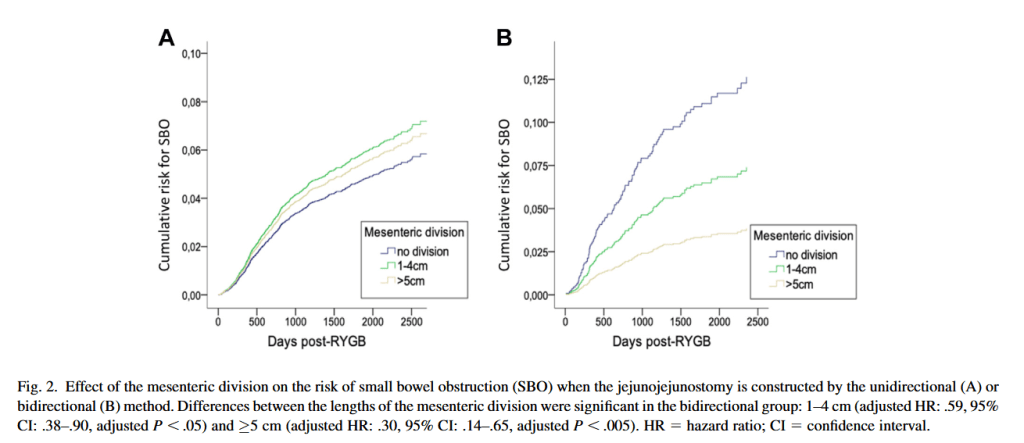
“The data from this analysis of specific surgical technical details when constructing the JJ in RYGB in a large series from a national quality register suggest that the choice of technique may affect the incidence of SBO after RYGB surgery. The finding that bidirectional stapling significantly reduces the 30-day incidence of SBO corroborates the findings of Munier et al. An explanation could be that bidirectional stapling prevents narrowing at the handsewn suture line and that early postoperative swelling/hematoma is less likely to cause complete obstruction.”
Hedberg, Suzanne et al. “Surgical technique in constructing the jejunojejunostomy and the risk of small bowel obstruction after Roux-en-Y gastric bypass.” Surgery for obesity and related diseases : official journal of the American Society for Bariatric Surgery vol. 18,9 (2022): 1151-1159. Free Full Text
 Surgical Focus