
“There are two strategies for heparin bridging; administration of intravenous unfractionated heparin (UFH), and subcutaneous low-molecular-weight heparin (LMWH). While both strategies reduce the risk of valve thrombus formation, they have distinct biomedical, financial, and logistical profiles. UFH is administered intravenously according to a nomogram and hence requires peri-procedural hospital admission and continuous monitoring of
activated partial thromboplastin time (aPTT). In contrast, LMWH is administered subcutaneously once or twice daily in an outpatient setting and usually does not require continuous blood monitoring of anti-Xa levels.”
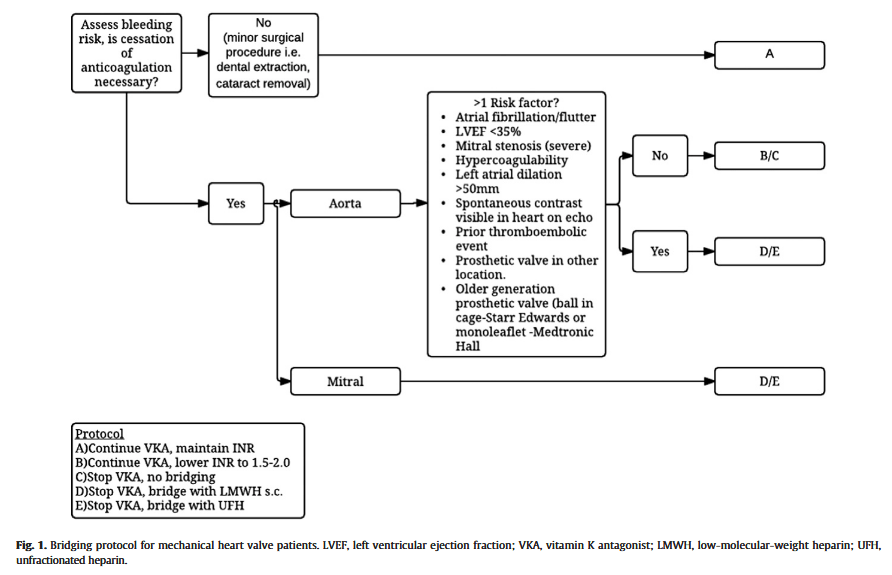
“With regards to bridging strategy, no difference was found in the 30-day incidence of adverse events between UFH and LMWH. Furthermore, the incidence of bleeding was considerably higher than the incidence of thromboembolism or death. Prospective studies
are needed to confirm our results and to fully elucidate the role of anticoagulant bridging in anticipation of an invasive procedure.”
Hart, E A et al. “Anticoagulant bridging in left-sided mechanical heart valve patients.” International journal of cardiology vol. 232 (2017): 121-126. Full Text for Emory Users
 Surgical Focus