
“Laparoscopic cholecystectomy is a well-established procedure with clear benefits for patients over open cholecystectomy. However, it is associated with an increased rate of
bile duct injury. Biliary injuries occur more commonly when operations are made more difficult due to the presence of severe acute and/or chronic inflammation. Under these conditions, secure ductal identification by the critical view of safety (CVS) may be very challenging because CVS requires clearing of the inflamed hepatocystic triangle in
order to demonstrate the cystic duct, cystic artery, and the cystic plate. It is a rigorous method, but as we have previously stressed, this is actually one of the strengths of the
CVS method of identification. The infundibular technique, in which the funnel-shaped infundibular-cystic duct junction is the rationale for identification, is much easier to achieve than CVS.”
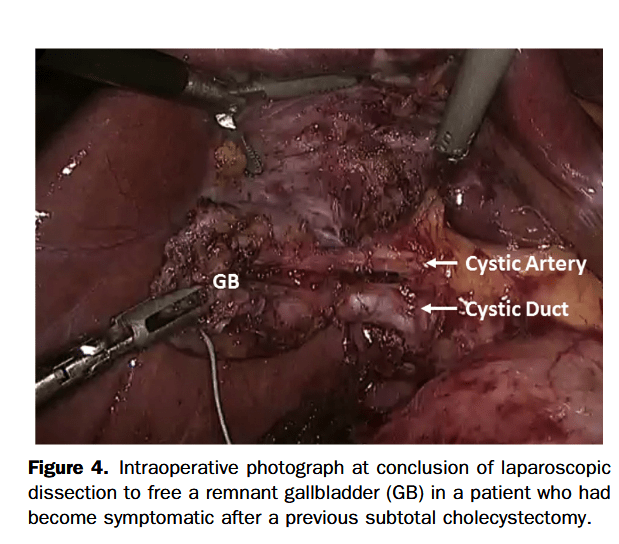
“Which technique is best may vary with the experience of the surgeon. For a surgeon experienced in minimally invasive techniques, a subtotal fenestrating cholecystectomy
with drain placement would seem to best fulfill the listed aims. However, for many surgeons, the safest approach will be to do an open procedure of the same type. The key principle, however, should not be lost in the details of the technique. That principle is that a subtotal fenestrating cholecystectomy is a standard operation that should be used liberally when surgeons encounter difficulty in getting to the CVS. We believe that clarification of the procedures and what they are called will help surgeons choose what type of procedure to select, and it will also facilitate the performance clinical studies in this area.”
Strasberg, Steven M et al. “Subtotal Cholecystectomy-“Fenestrating” vs “Reconstituting” Subtypes and the Prevention of Bile Duct Injury: Definition of the Optimal Procedure in Difficult Operative Conditions.” Journal of the American College of Surgeons vol. 222,1 (2016): 89-96. Full Text for Emory Users
 Surgical Focus