
“Although surgery is the recommended treatment for adult intussusception, the optimal surgery remains controversial. Although abdominal computed tomography (CT) scan has
proven useful in diagnosing intussusception, it has limited value in discriminating whether a lead point is malignant, benign, or idiopathic. Reduction at surgery may avoid excessive bowel resection, although it can theoretically increase the risk of potential intraluminal seeding or venous tumor dissemination.
The aim of this study was to determine what the appropriate surgical procedure for adult intussusception is, depending on location of the intussusception or other specific situations.”
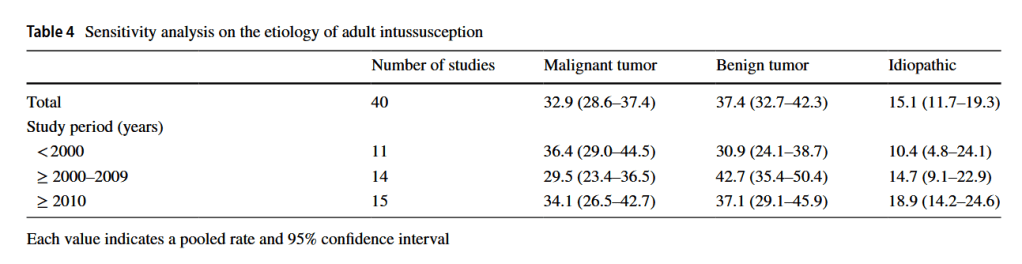
“Surgery remains the mainstay in adult intussusception. Enteric intussusception is the most common variety in adults and should generally be managed by initial reduction, followed by resection since the main causes of malignant tumor are metastatic carcinoma, lymphoma, and GIST. Colonic intussusception should be resected en bloc due to the high rate of primary adenocarcinoma. However, a selective approach seems appropriate for ileocolic adult intussusception because of its intermediate nature between enteric and colonic sites. Due to the increasing incidence of idiopathic etiologies combined with high postoperative morbidity and mortality, thorough diagnostic evaluation and medical optimiziation, should precede surgery in stable patients without an emergency indication for surgery.”
Hong, K D et al. “Adult intussusception: a systematic review and meta-analysis.” Techniques in coloproctology vol. 23,4 (2019): 315-324. Full Text for Emory Users
 Surgical Focus