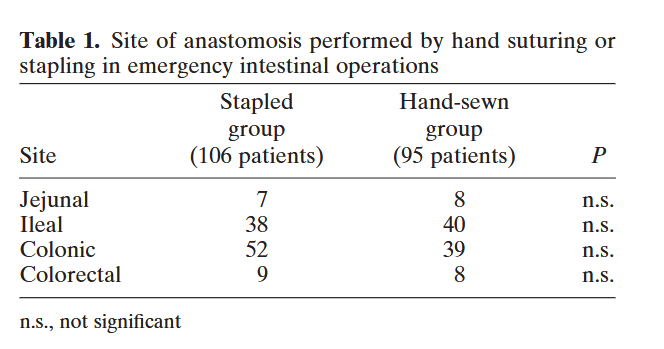
“Since Ravitch and Steichen introduced a modified form of the Soviet-developed stapling instruments in the 1960s, various types of staplers and stapling techniques have been adopted worldwide. There are two main types of stapled intestinal anastomoses: anatomical end-to-end anastomoses, performed with circular staplers, and functional side-to-side anastomoses, performed with linear staplers. According to several studies, stapled anastomoses have rendered hand-sewn anastomoses obsolete. It is known that less time is required for stapled intestinal anastomosis than for conventional hand-sewn anastomosis, and that the rate of anastomostic-related complications after stapling is acceptably low. However, some articles have pointed out that stapled anastomoses are unfavorable in certain situations. To our knowledge there are no papers in the literature comparing stapled and manual anastomosis in emergency traumatic or nontraumatic intestinal surgery. Thus, we conducted a prospective randomized study to compare emergency intestinal surgical
stapling with manual suturing.”