
“With the continued dramatic rise in the widespread role of imaging in diagnosis and management of patients, there is a resultant rise in detection of asymptomatic incidental liver lesions. Common imaging modalities in which incidental liver lesions are detected include ultrasonography (US) with or without contrast agent (CEUS), computed tomography (CT), and magnetic resonance imaging (MRI) for abdominal or nonabdominal indications (breast and spine). Studies show a continued upward trend in utilization of CT/MRI/US imaging in adults in the United States and Canada, inevitably resulting in increased detection of incidental FLLs within the liver. In fact, some studies show that up to 52% of patients without cancer have a benign liver lesion at autopsy. The American College of Radiology reports that up to 15% of patients have an incidental liver lesion detected
on routine nonsurveillance imaging. Therefore, it is critical to understand appropriate management of incidentally detected benign FLLs because they have differing clinical implications from malignant lesions such as hepatocellular carcinoma (HCC), intrahepatic cholangiocarcinoma (iCCA), and metastatic disease.”
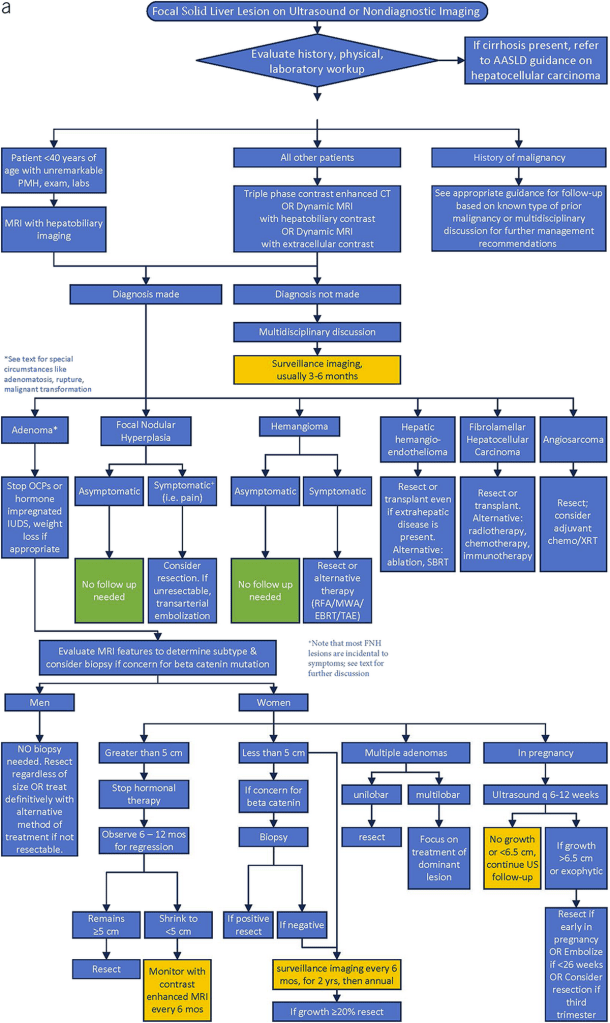
“FLLs continue to be a frequent source of concern for providers and patients alike, and detection will likely continue to rise in incidence as an increasing volume of radiographic imaging studies are being performed. Many FLLs are benign, but it is important to understand indications for further workup, including multidisciplinary discussion, biopsy, and need for surveillance imaging to ensure that a malignancy is not missed. The clinical history, physical examination, underlying comorbidities, and laboratory workup are an important part of the evaluation of these patients, which, when combined with improved diagnostic
imaging, can frequently lead to a diagnosis without the need for biopsy.”
Frenette, Catherine et al. “ACG Clinical Guideline: Focal Liver Lesions.” The American journal of gastroenterology vol. 119,7 (2024): 1235-1271. Full Text for Emory Users
 Surgical Focus