
“Central venous catheters (CVC) are commonly used for monitoring and administering medication. The Seldinger technique is routinely used for CVC insertion; however, this technique has an inherent risk of guidewire retention. The mechanism behind guidewire retention is debated, with some authors reporting cases where guidewires “slip” or are sucked into the vasculature at the point of insertion, presumably due to physiological blood flow exhibiting a force on the guidewire that overcomes the frictional force between the guidewire and the CVC lumen, which should prevent guidewire slippage. This is the basis for widely adopted guidance that mandates that operators should hold onto the guidewire at all times while it remains intravascular during CVC insertion. However, this may be an
oversimplification of retention events, as most guidewires are likely to remain intraluminally should the operator inadvertently take their hand off them during the procedure. Indeed, the forces exerted by blood flow and pressure differentials are much greater during arterial
procedures, although in the opposite direction. If these forces were sufficient to overcome friction, guidewires would be ejected from catheters whenever the operator took his/her hand off the guidewire. When retention occurs, the guidewire can migrate from the catheter
into the patient’s vasculature and heart and may cause complications such as arrhythmia, vascular damage, thrombosis, cardiac perforation, and tamponade.”
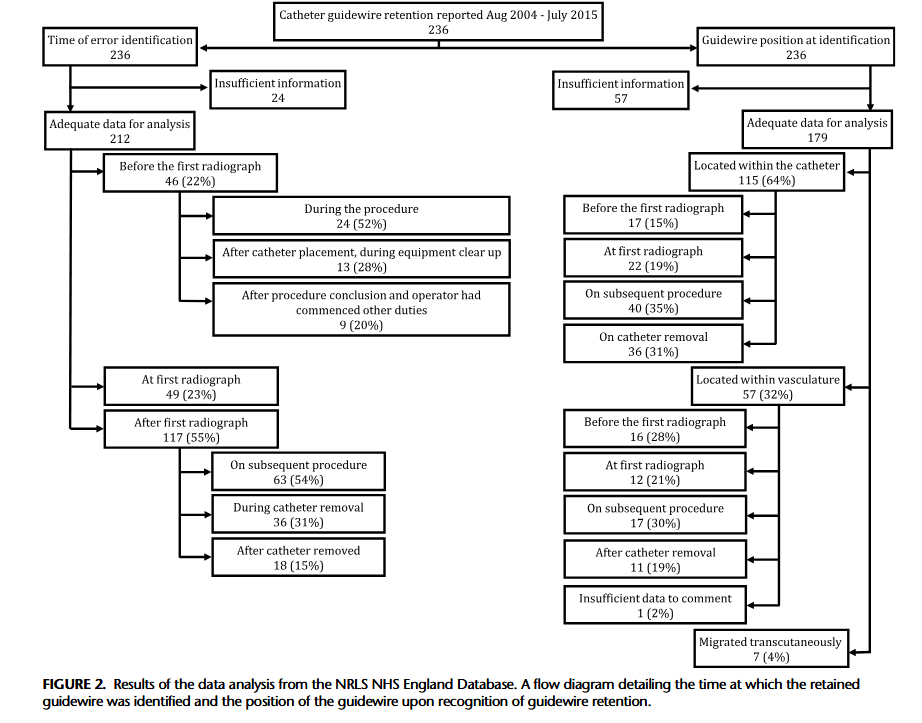
“Retention of the whole guidewire during CVC insertion is a preventable event that should not occur. This event not only causes direct harm to patients but may lead to a “second victim” phenomenon in the clinician who makes the mistake, and can cause reputational harm to health care institutions. In addition to the requirement for avoidable procedures and surgery, fatalities have also been reported as a direct consequence of retained guidewires. Preventative approaches traditionally include introduction of audit, checklists, extra documentation, or reeducation and retraining of staff after the incident occurs. Despite
the introduction of these techniques and national guidance from NHS England, the NRLS database confirms that CVC guidewire retention is common, is reported on average twice per month, and has a rising frequency. Increased awareness and reporting, as well as an increase in the number of lines being placed during this 10-year period, are all likely contributing factors to the rising frequency of incidents seen.”
Mariyaselvam, Maryanne Z A et al. “Central Venous Catheter Guidewire Retention: Lessons From England’s Never Event Database.” Journal of patient safety vol. 18,2 (2022): e387-e392. Full Text for Emory Users

