
“Hemorrhoids are vascular structures that arise from a channel of arteriovenous connective tissues and drain into the superior and inferior hemorrhoidal veins. Although hemorrhoids are categorized as external or internal based on their relationship with the dentate line, they communicate with one another and often coexist. Symptoms related to hemorrhoids are very common in the Western hemisphere and other industrialized societies. Although published estimates of prevalence vary, hemorrhoidal disease represents one of the most common medical and surgical disease processes encountered in the United States, resulting in more than 2.2 million outpatient evaluations per year. Many diverse symptoms may be, correctly or incorrectly, attributed to hemorrhoids by both patients and referring physicians. As a result, it is important to identify symptomatic hemorrhoids as the underlying source of the
anorectal report and to have a clear understanding of the evaluation and management of this disease process. These guidelines address diagnostic and therapeutic modalities
in the management of hemorrhoidal disease.”
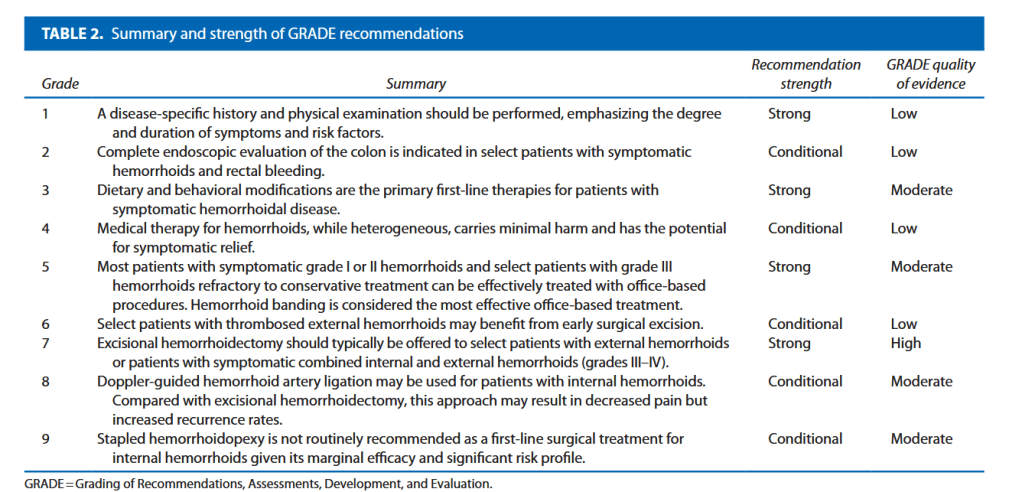
“The final grade of recommendation and level of evidence for each statement were determined using the Grades of Recommendation, Assessment, Development, and
Evaluation (GRADE) system. The certainty of evidence reflects the extent of our confidence in the estimates of effect. Evidence from randomized controlled trials (RCTs) start as high certainty and evidence from observational studies start as low certainty. For each outcome,
the evidence is graded as high, moderate, low, or very low. Recommendations are influenced by considering risk of bias, inconsistency, indirectness, imprecision, and publication bias. The certainty of evidence based on observational studies can be rated up when there is a large magnitude of effect or dose–response relationship.”
Hawkins, Alexander T et al. “The American Society of Colon and Rectal Surgeons Clinical Practice Guidelines for the Management of Hemorrhoids.” Diseases of the colon and rectum vol. 67,5 (2024): 614-623. Full Text for Emory Users

