
“Trauma to abdominal wall blood vessels occurs in 0.2% to 2% of laparoscopic procedures. Both superficial and deep abdominal wall vessels are at risk. The superficial vessels may be located by transillumination; however, the deep epigastric vessels cannot be effectively located by transillumination and, thus, other techniques should be used to minimize the risk of injury to these vessels.”
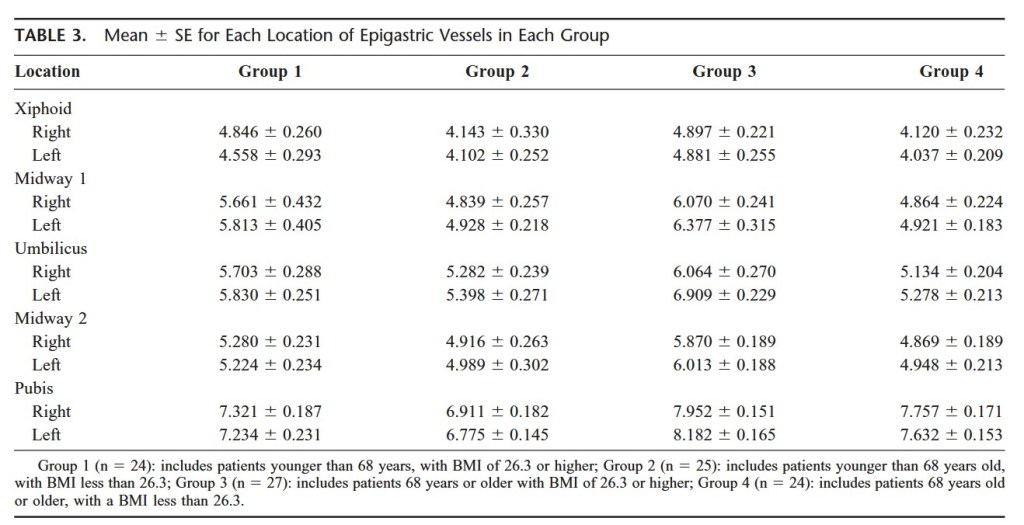
“The complexity of advanced laparoscopic procedures necessitates placement of many large-bore trocars through the anterior abdominal wall. This can result in accidental injury
to the abdominal wall vessels in 0.2% to 2.0% of cases. Undoubtedly, the most commonly injured vessel in laparoscopic procedures is the epigastric vessels. Injury to the epigastric vessels can result in different clinical presentations. During laparoscopy, bleeding may
be manifested as oozing externally around the port site or dripping internally along the shaft of the cannula into the abdominal cavity. The injury may initially go unrecognized due to the temporary tamponade by both the cannula and pneumoperitoneum and present as hematoma or pseudoaneurysm later.”
Saber, Alan A et al. “Safety zones for anterior abdominal wall entry during laparoscopy: a CT scan mapping of epigastric vessels.” Annals of surgery vol. 239,2 (2004): 182-5. Free Full Text

