
“Hepatic resection has been thought to he the most effective treatment modality for selected patients who have left-sided hepatolithiasis and meet the criteria of resection.” Under the same criteria the role of right hepatic resection, especially right hepatic lobectomy, is still ambiguous for patients who have right-sided hepatolithiasis because of the higher operative risk. This report presents the results of right hepatic lobectomy in the treatment of patients with right-sided hepatolithiasis after careful selection. In particular, we focus on the
rationale and indications for this procedure,”
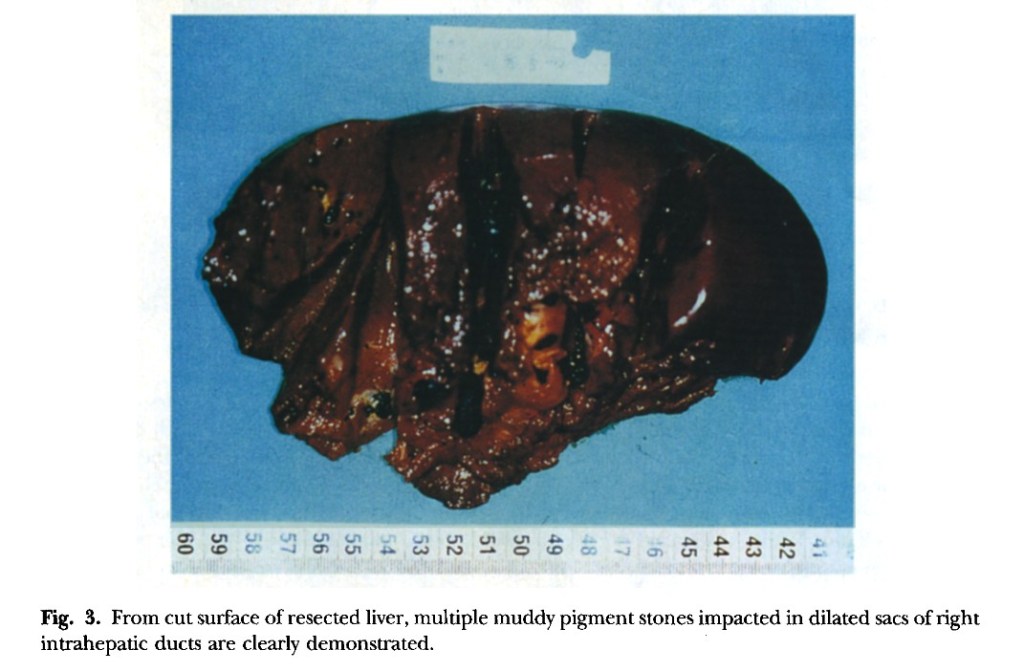
“Isolated right-sided hepatolithiasis is less common than left-sided hepatolithiasis. The reported incidence of isolated right-sided hepatolithiasis is about 24.7% in Japan,’ 14.6% in Hong Kong,g and 16.8% in Taiwan.’ In our series the incidence was 13.6% (23 of 169). If
untreated or inadequately treated, hepatolithiasis associated with repeated cholangitis could lead to progressive biliary strictures, liver abscesses, atrophy of the affected liver, liver cirrhosis, and portal hypertension. In addition, there appears to be an association between
intrahepatic cholangiocarcinoma and long-standing hepatolithiasis. In the past the results of treatment were unsatisfactory as a result of the high incidence of residual stones and the high stone recurrence rate. Recently, the advances in hepatobiliary imaging, the availability of flexible choledochoscopy, the application of stone-fragmentation technology, and the innovative surgical technique to the hepatobiliary system have modified the management of this disease.”
Hung, C J, and P W Lin. “Role of right hepatic lobectomy in the treatment of isolated right-sided hepatolithiasis.” Surgery vol. 121,2 (1997): 130-4. Full Text for Emory Users

