
“Feeding jejunostomy is conventionally done via laparotomy. However, since laparoscopic jejunostomy was introduced in 1990, the procedure is constantly advancing with new techniques and devices. It was demonstrated to be a safe, feasible, and cost-effective technique with comparable complication rate to open feeding jejunostomy.”
“In addition, compared with the conventional open procedure, the laparoscopic approach has the inherit merits of smaller incisions, better cosmesis, less postoperative pain, and earlier recovery. With the aim of achieving early enteral feeding and a reduction in postoperative morbidity, any complications arising from the procedure will jeopardize its benefits, incur additional costs, and delay subsequent oncologic treatment.”
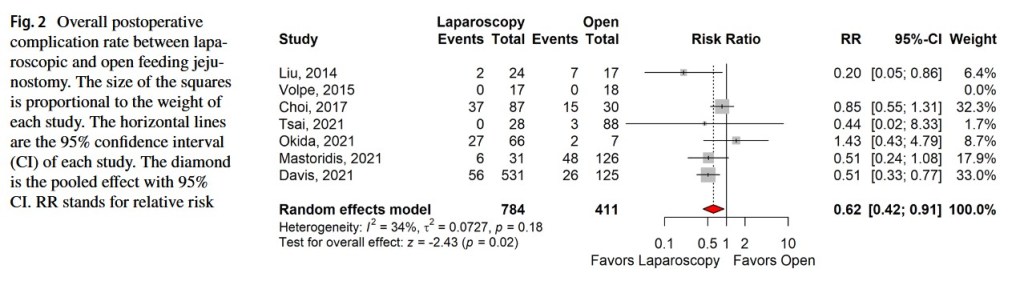
“This systemic review and meta-analysis of seven studies and 1195 patients revealed that the laparoscopic approach of feeding jejunostomy might reduce the postoperative complications compared with the conventional open approach (RR 0.62 [95% CI, 0.42–0.91], p = 0.02, low certainty of evidence). The between-study heterogeneity was low-moderate (I2 = 34%, p = 0.18), showing relatively consistent results across the studies. We also analyzed the severity of complications and found fewer major and minor complications in the feeding jejunostomy group; however, only two studies were included in this subgroup analysis, and only the minor complications analysis was statistically significant. Finally,
we conducted a subgroup analysis to exclude the major concomitant procedures. The complication rate was lower in the laparoscopic group, identical to the primary outcome.”
Hsiung, Ted et al. “Laparoscopic vs. open feeding jejunostomy: a systemic review and meta-analysis.” Surgical endoscopy vol. 37,4 (2023): 2485-2495. doi:10.1007/s00464-022-09782-x Full Text for Emory Users

