
“The treatment of high-grade carotid-artery stenosis varies considerably internationally. Some countries limit revascularization primarily to patients with symptoms, whereas others more commonly recommend that asymptomatic patients undergo revascularization. In the United States, 75 to 80% of patients who undergo carotid-artery stenting or endarterectomy are asymptomatic. Randomized trials from the 1990s and early 2000s showed that carotid
endarterectomy led to a lower risk of stroke among asymptomatic patients with high-grade
stenosis than medical therapy. Improvements in carotid endarterectomy, carotid-artery
stenting, and medical therapy and the results of two recent small trials have challenged
our understanding of appropriate treatments. Here, we present results from the Carotid
Revascularization and Medical Management for Asymptomatic Carotid Stenosis Trials
(CREST-2), which tested whether carotid artery stenting or carotid endarterectomy plus
intensive medical management would be superior to intensive medical management alone
for preventing stroke in patients with high-grade carotid stenosis without recent stroke
symptoms.”
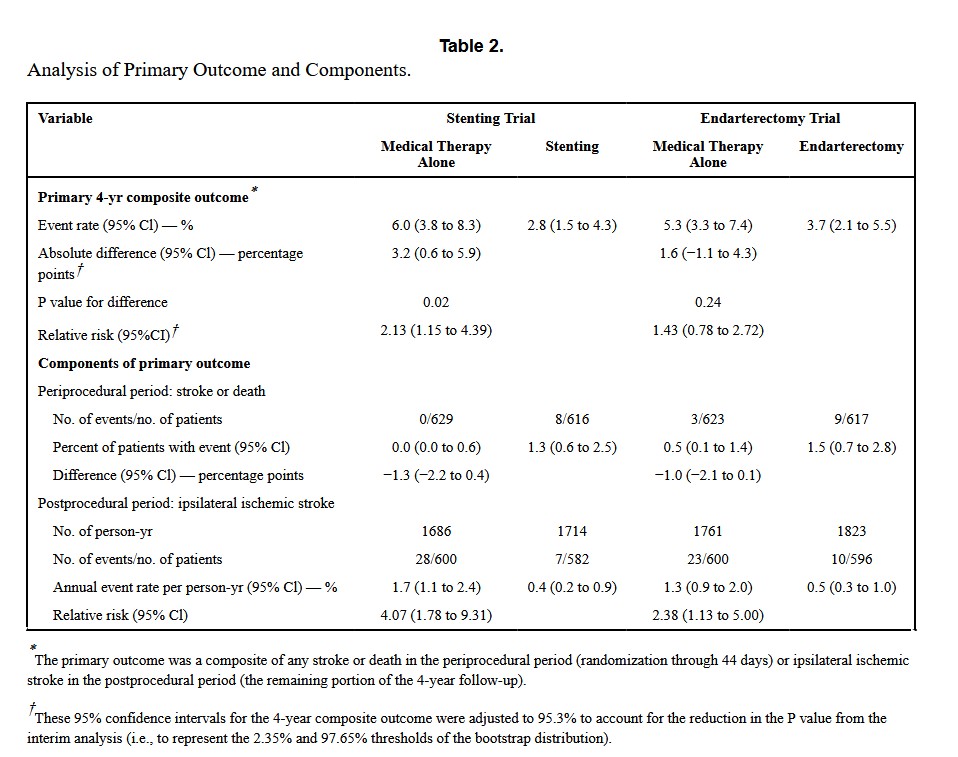
“Among participants with asymptomatic high-grade carotid stenosis, the stenting trial showed that the addition of transfemoral carotid-artery stenting to intensive medical management led to a significantly lower risk of the primary composite outcome (periprocedural stroke or death or postprocedural ipsilateral stroke within 4 years) as compared with intensive medical management alone (2.8% vs. 6.0%). The absolute risk difference of 3.2 percentage points was significant, corresponding to a number needed to treat of 31 to prevent one primary-outcome event.
In the endarterectomy trial, we found no significant difference in the 4-year incidence of
primary-outcome events (5.3% in the medical therapy group and 3.7% in the endarterectomy
group). The event rate among patients who had been assigned to a revascularization group
appeared to be similar in the two trials. Results appeared to be consistent across
subgroups in the two trials.
The program of intensive medical management had similar effects on control of risk
factors across the treatment groups in the two trials. The CREST-2 team diligently
monitored the risk-factor status of all patients and worked closely with the trial sites to
improve control. Furthermore, a commercial company worked directly with patients on
risk-factor management.”
Brott, Thomas G et al. “Medical Management and Revascularization for Asymptomatic Carotid Stenosis.” The New England journal of medicine vol. 394,3 (2026): 219-231. Free Full Text

