
“Colorectal cancer (CRC) represents a major worldwide health care burden, as the
second most common cancer diagnosed in women and third most common in men,
and accounting for 10% of all annually diagnosed cancers and cancer-related deaths
worldwide.
As result of improvements in detection through screening, better referral
pathways, centralisation of services, effective primary surgery, development of
systemic chemotherapy, biological agents, and understanding of tumour biology,
survival rates following diagnosis have improved.
Nevertheless, at least 25%-50% of patients with CRC develop colorectal liver
metastases (CRLM) during the course of their illness.”
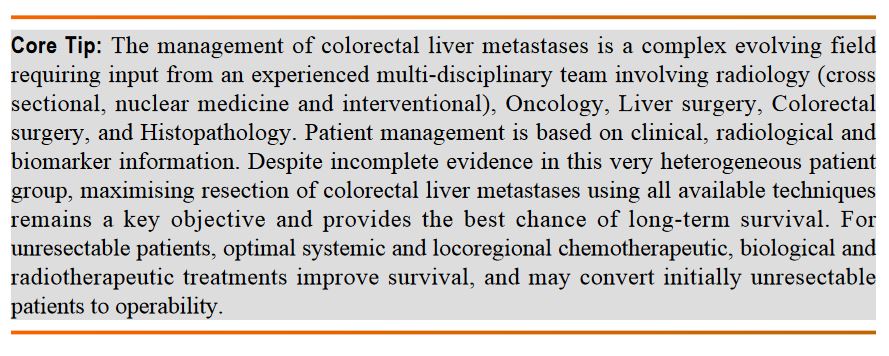
“The management of colorectal liver metastases is highly complex owing to multiple
treatment modalities. Adding to this complexity is the marked heterogeneity of the
patient group, and the nuanced overlap between ‘different’ scenarios. In this context,
no single specialty team, let alone individual clinician, is solely equipped to carry out
optimal decision making.
Effective management results from careful and informed discussion from an
experienced multi-disciplinary team involving radiology (cross sectional, nuclear
medicine and interventional), Oncology, Liver surgery, Colorectal surgery, and
Histopathology.”
Martin J, Colorectal liver metastases: Current management and future perspectives. World J Clin Oncol. 2020 Oct 24;11(10):761-808.
 Surgical Focus