
“Distal Pancreatectomy (DP) is performed for both benign and malignant conditions affecting the body and tail of the pancreas. DP is also performed for chronic pancreatitis and occasionally for abdominal trauma. With improvements in imaging, surgical technology and technique, and postoperative care, the mortality from DP at high-volume centers is approximately 1 per cent. Despite the low mortality rate from DP, the morbidity rate from this procedure remains high (24 to 64 per cent in some series) with pancreatic fistula (PF) as
a common concern. Even with the use of linear stapling devices, fibrin glue, somatostatin analogs, thermal sealing devices, and mesh staple line reinforcement, PF continues to be a burden to patient quality of life and healthcare resources for those patients undergoing DP.”
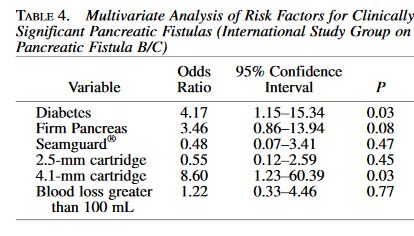
“The PF rate at the author’s institution after stapled pancreatic transection is similar to rates in the current literature; thus, stapled gland transection is an acceptable approach to DP. Patient characteristics such as DM are associated with clinically significant PF formation. The exact mechanism by which DM affects pancreas consistency has yet to be determined, but diabetic
patients should be counseled on their risk of PF in the preoperative period. In addition, staple size is an important determinant of leak rates. A large staple size may inadequately seal the distal pancreatic remnant, predisposing to PF formation, and as such, the smallest staple that can transect the pancreas should be used to reduce PF rates. Lastly, the association between mesh staple line reinforcement and PF requires further clarification. PF remains a challenging complication after DP, and more studies are required to identify potential risk factors.”
Subhedar, Preeti D et al. “Risk factors for pancreatic fistula after stapled gland transection.” The American surgeon vol. 77,8 (2011): 965-70.
 Surgical Focus