
“Despite their frequent occurrence, DD are asymptomatic in 95% of cases, while 1 to 5% eventually become symptomatic. Intervention is indicated only for symptomatic duodenal diverticula(DD). Complications related to DD are rare but may be very severe; they include biliary or pancreatic obstruction, duodenal obstruction, perforation, or hemorrhage.
Endoscopic treatment is usually the first-line approach to biliopancreatic complications related to juxtapapillary DD and also for hemorrhagic complications. Indirect surgical
treatments include bilio-enteric bypasses and even duodenal exclusion. Direct surgical treatment consists of duodenal diverticulectomy, which has significant morbidity and mortality; prophylactic excision of asymptomatic DD is therefore not recommended.”
KEY POINTS
- “The duodenum is the second most common site of intestinal diverticula after the colon.
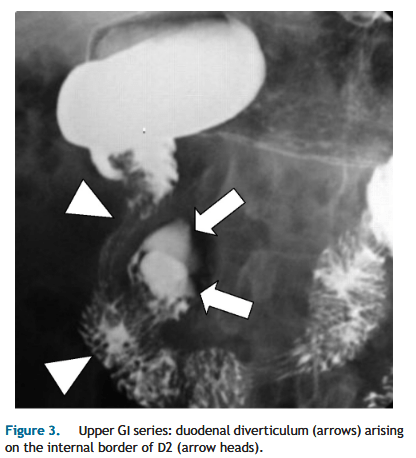
- The majority of duodenal diverticula are localized in the second portion of the duodenum.
- Extraluminal DD are usually asymptomatic and discovered incidentally.
- Only symptomatic or complicated duodenal diverticula should be treated.
- Complications of DD arise in 5% of cases: biliary, pancreatic, or duodenal obstruction, hemorrhage, or perforation. Biliopancreatic complications are most common.
- If the patient presents with biliopancreatic manifestations due to a juxtapapillary DD,
endoscopic sphincterotomy is the first treatment choice. Indirect surgical treatment includes
biliodigestive bypass and even, for some authors, duodenal exclusion. - Surgical treatment of perforated duodenal diverticulum usually calls for diverticulectomy,
sometimes in association with a bypass or duodenal exclusion. - During performance of diverticulectomy, the papilla and common bile duct must be clearly
identified from the outset to avoid inadvertent injury. - Simple suture closure of the duodenal wall after diverticulectomy is associated with a risk of
duodenal fistula, which carries a mortality of 20% to 30%. - Initial treatment of hemorrhage from DD should be endoscopic hemostasis. Open surgical
diverticulectomy is indicated for massive hemorrhage and/or recurrent bleeding. - Intraluminal duodenal diverticula are rare but are often symptomatic requiring endoscopic or
surgical treatment.”
Oukachbi, N, and S Brouzes. “Management of complicated duodenal diverticula.” Journal of visceral surgery vol. 150,3 (2013): 173-9. doi:10.1016/j.jviscsurg.2013.04.006 Free Full Text
 Surgical Focus