
“Eleven years after its definition, postoperative pancreatic fistula (POPF) still remains one of the most harmful complications after pancreatic resection. Despite all the advances and technical modifications developed during this past decade to prevent POPF, the incidence of this dreaded complication still ranges between 3–45 % of pancreatic operations at high-
volume centers. Updating the ISGPF classification is both relevant and clinically important,
because POPF remains the single main determinant of serious postoperative morbidity and mortality related to pancreatic resection and plays a major role in terms of operation-related mortality, morbidity, hospital stay, and economic impact.”
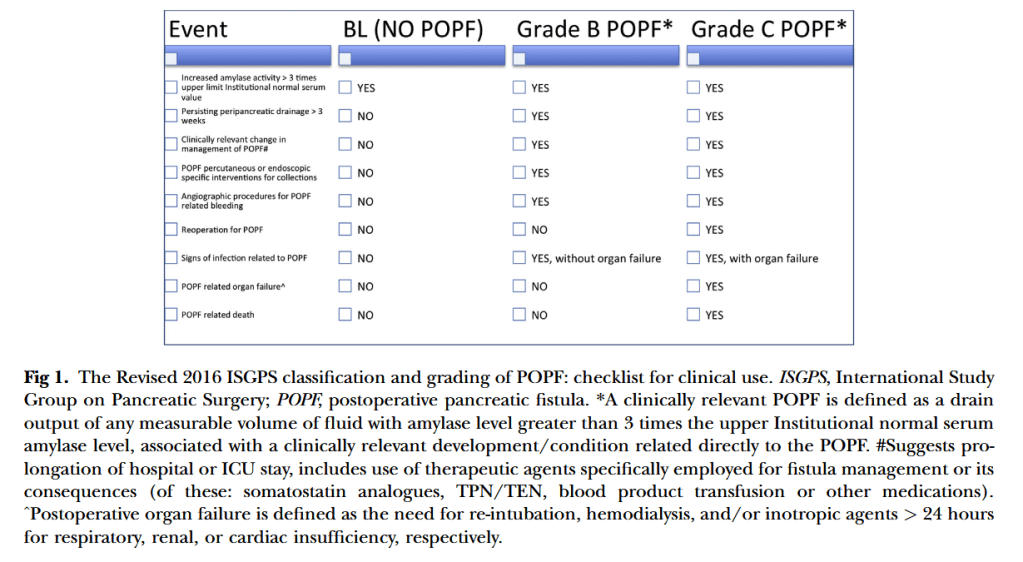
“The conclusions of the 2005 ISGPF publication suggested that the use of the proposed classification of POPF would confirm its clinical value and allow accurate comparison across different surgical practices internationally. Indeed, 11 years later, the ISGPS has re-evaluated the impact of this original classification and can attest that the original goals
in creating the classification have been reached. We now speak a common language for many aspects of pancreatic operation, and POPF has become a standardized definition in our clinical lexicon. The number of citations of the original 2005 ISGPF article (n = 1,707) and the almost universal acceptance of the definition and classification of POPF re-inforces this concept. The use of the ISGPF classifications have provided the ability to better assess the efficacy of numerous operative approaches and mitigation strategies, and analyse surgical performance. The strength of the original 2005 ISGPF classification was both its brevity and objective simplicity as well as its clinical applicability.
Bassi, Claudio et al. “The 2016 update of the International Study Group (ISGPS) definition and grading of postoperative pancreatic fistula: 11 Years After.” Surgery vol. 161,3 (2017): 584-591. Full Text for Emory Users
 Surgical Focus