
“Despite advancements in operative technique and improvements in postoperative outcomes, pancreatic fistula is widely considered to be the most common and
troublesome complication after pancreatic resection. It represents the factor most often linked with postoperative mortality, certain complications such as delayed gastric emptying, longer hospital stays, readmissions, and increased costs. Furthermore, it frequently delays
timely delivery of adjuvant therapies, and reduces overall patient survival. Placement of pancreatic duct stents, the use of somatostatin analogs or adhesive sealants, or modifications in reconstruction technique have done little to change the incidence or alter the impact of postoperative pancreatic fistulas (POPF).”
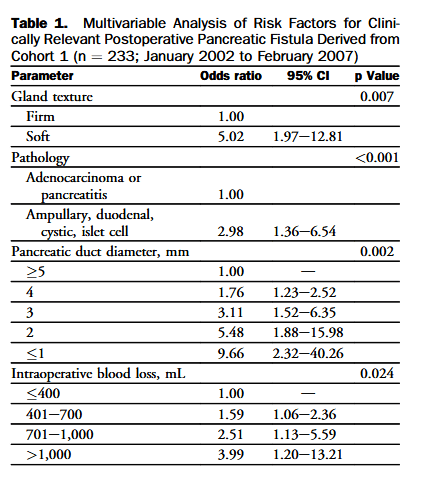
“Despite these limitations, we have derived a simple 10-point Fistula Risk Score, accrued from ISGPF risk factors, which accurately predicts, with excellent discrimination, the development of clinically relevant postoperative pancreatic fistula after pancreatoduodenectomy. The strength of this study lies in the ability to validate this
scoring system in a large population of patients in a pancreatic surgery specialty practice. This system, which can be easily incorporated into the surgeon’s operative note, has the potential to act as an objective description of risk for comparative studies of pancreatic fistula prevention and management in the future. This Fistula Risk Score can be readily learned, and can help surgeons anticipate, identify, and control pancreatic fistula proac-
tively, with the aim of achieving better outcomes from this daunting postoperative complication.”
Callery, Mark P et al. “A prospectively validated clinical risk score accurately predicts pancreatic fistula after pancreatoduodenectomy.” Journal of the American College of Surgeons vol. 216,1 (2013): 1-14. Full Text for Emory Users

