
“Upper extremity DVT may be complicated by recurrent thrombosis in about 7.5% of cases and by post-thrombotic syndrome in 19.4% of cases, with higher rates of recurrence in patients with cancer-associated thrombosis and of post-thrombotic syndrome in patients with unprovoked thrombosis or related to congenital or anatomical abnormalities. The intensity and duration of anticoagulant treatment need to be balanced against the risk of bleeding
complications, especially in high-risk subgroups like patients with cancer in whom major bleeding events were reported in up to 10%.”
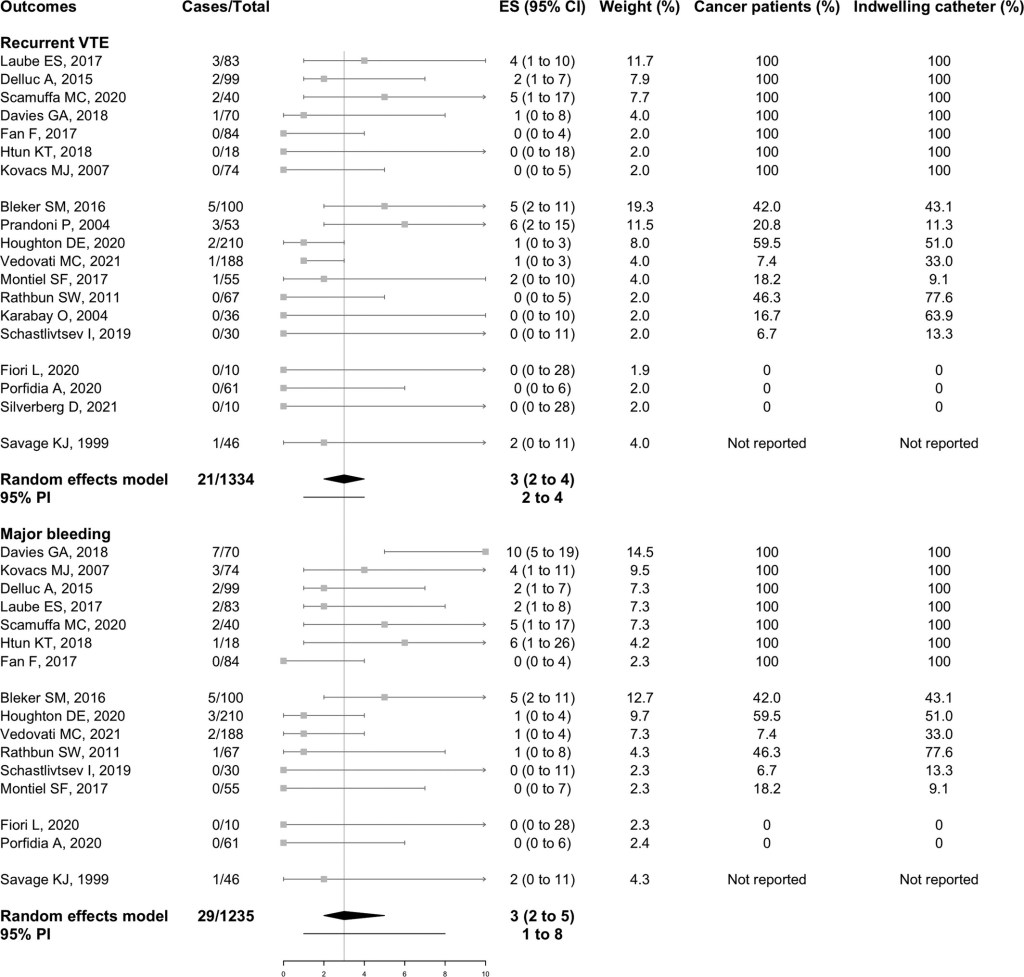
“VTE have an increased risk of bleeding and recurrent thrombosis during anticoagulant therapy, which may be as high as 4.3% and 8.2%, respectively.48 The presence of an indwelling catheter in the upper arms represents a frequent and transient additional
thrombotic risk factor in cancer patients because of local vessel wall mechanical damage and blood coagulation activation from infused medications. Along with anticoagulant therapy, withdrawal of toxic medications and removal of venous lines represent the recommended management of catheter-related UEDVT and may justify the slightly lower rate of recurrent VTE in our analysis (2.0%) compared with patients with cancer and usual site VTE (between 5.2% and 8.2%).”
Valeriani, Emanuele et al. “Anticoagulant treatment for upper extremity deep vein thrombosis: A systematic review and meta-analysis.” Journal of thrombosis and haemostasis : JTH vol. 20,3 (2022): 661-670.

