
“Perioperative venous thromboembolism (VTE) is a frequent complication in patients who undergo major surgical procedures. The risk for thromboembolism is increased in patients with advancing age, malignancy, inherited and acquired thrombophilic conditions, and in those patients who undergo certain higher-risk surgical procedures (for example: total hip arthroplasty, total knee arthroplasty, and abdominal cancer operations). A history of deep vein thrombosis (DVT) or pulmonary embolism (PE) frequently is cited as a risk factor for subsequent recurrence around the time of surgery. However, the incidence of perioperative VTE recurrence in patients with a history of lower extremity deep vein thrombosis is not well studied.”
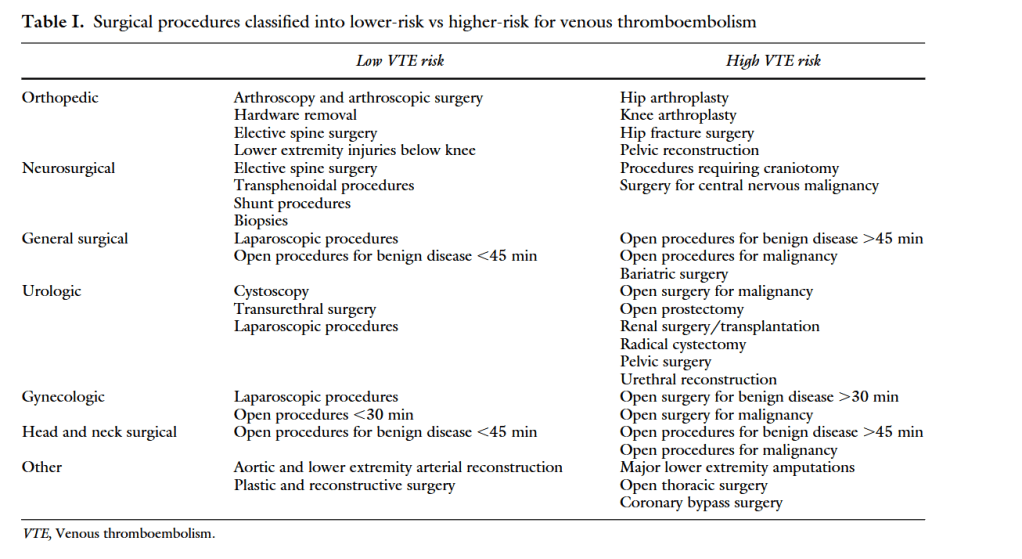
“The ACCP Consensus Statement provides guidelines regarding the perioperative management of anticoagulation in patients with prior VTE. Patients are stratified according to the time interval between the original DVT or PE and the subsequent surgery: 3 months is considered high-risk, 3 to 12 months is considered moderate-risk, and 12 months is considered low-risk for perioperative VTE recurrence. In our current study, the median time interval between the original DVT and surgery was only 3 weeks, and 71% of the surgeries were performed within 3 months of the DVT. Therefore, the majority of our patients were in
the highest risk interval, and it is likely that most of these patients were undergoing urgent surgical procedures in a high-acuity setting. Supporting this notion is the fact that 28% of the original DVTs were in association with trauma, and only 12% were considered idiopathic venous thromboses. These patients may not be an accurate reflection of a more elective surgical population in whom surgery may be delayed to decrease the potential for VTE recurrence”
Liem, Timothy K et al. “Symptomatic perioperative venous thromboembolism is a frequent complication in patients with a history of deep vein thrombosis.” Journal of vascular surgery vol. 52,3 (2010): 651-7.

