
“Currently, there are no effective medical therapies proven to benefit symptomatic PCLD. Some data exist to support the use of somatostatin analogs in the treatment of hepatomegaly due to PCLD; however, the durability of their efficacy remain in question. Vasopressin receptor antagonists, ursodeoxycholic acid, and protein kinase inhibitors
have also been investigated in the management of symptomatic PCLD, but none has been shown to reduce liver volume sufficiently for symptom improvement. With the lack of medical therapies, management of advanced PCLD relies on procedural intervention. Cyst aspiration may be sufficient in patients with a single large cyst; however, with the innumerable cysts present in PCLD, aspiration is frequently ineffective.”
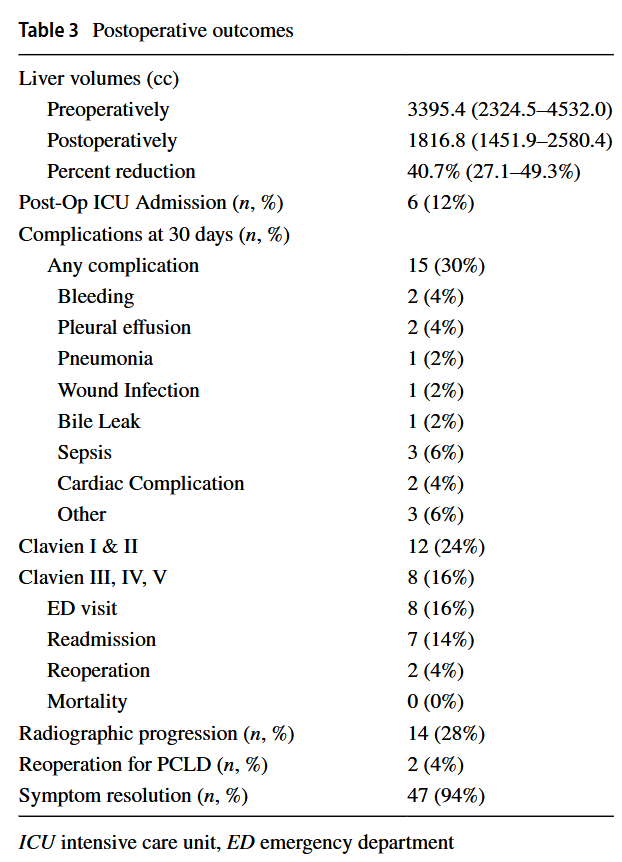
“Given the progressive nature of PCLD, its management continues to be a clinical challenge. Roediger and colleagues highlighted the knowledge gap regarding the optimal therapy for PCLD. While several medical therapies have shown promise in liver volume reduction, the authors conclude that surgical management of PCLD provides only short-term benefits largely in part due to the treatment of dominant cysts, while allowing smaller remnant cysts to progress leading to symptom recurrence. The existing literature also suggests a high complication rate associated with open surgical management of PCLD,
approaching nearly 60% in some series. In our series of 50 patients undergoing surgical debulking with resection for symptomatic PCLD, we demonstrate a high rate of symptom resolution with minimal surgical morbidity, likely secondary to the significant use of a laparoscopic approach in our series. These data suggest surgical management is a sustainable treatment option for symptomatic PCLD, while highlighting the improved surgical morbidity utilizing a minimally invasive approach.”
Smith SR, Matar AJ, Polireddy K, Feltracco HA, Sarmiento JM. Operative Outcomes for Polycystic Liver Disease: Results of a Large Contemporary Series. J Gastrointest Surg. 2023 Nov;27(11):2444-2450.

