
“Intraoperative cholangiography (IOC) helps to clarify the biliary tree anatomy, detect common bile duct (CBD) stones, and may prevent or promptly detect BDI. However,
the use of routine (RC) or selective (SC) IOC remains controversial. Some authors have suggested that RC allows for early detection of BDI and repair in the same surgical
procedure, reducing morbidity and mortality.6–8 Also, IOC facilitates the detection and treatment of CBD stones, reducing potential complications and readmissions. In
contrast, opponents emphasize that RC often detects asymptomatic CBD stones leading to unnecessary procedures, increases operating time, costs, and exposes the surgical team and patients to radiation.”
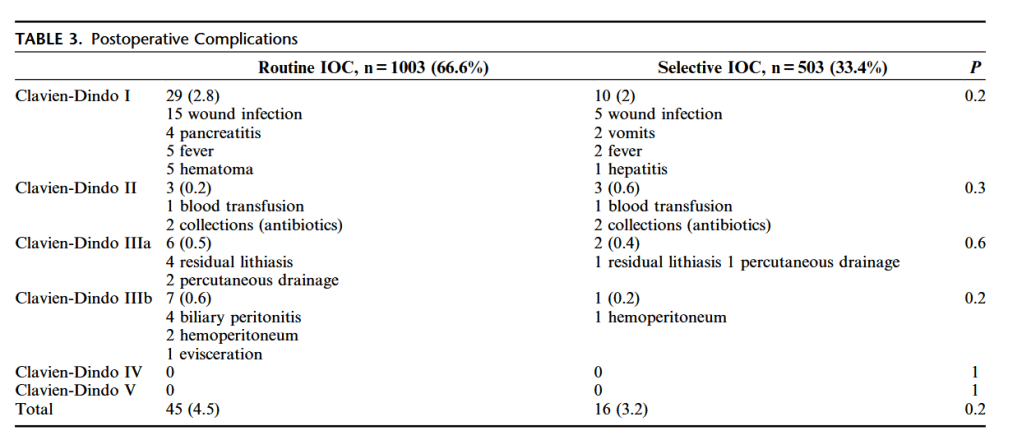
“This study aimed to compare the utility of routine versus selective IOC in a large cohort of patients undergoing LC. We found that: (1) the use of preoperative risk factors for CBD stones as an indication for selective IOC resulted in higher rates of IOC positivity and CBD stone detection; (2) the selective IOC approach resulted in similar residual lithiasis rates, compared with routine IOC; and (3) neither selective nor routine IOC was able to prevent or
identify BDI.”
Principe, Josefina et al. “Routine or Selective Intraoperative Cholangiography?: A Single-Center Analysis of 1506 Laparoscopic Cholecystectomies.” Surgical laparoscopy, endoscopy & percutaneous techniques vol. 36,3 e1453. 1 Jun. 2026 Full Text for Emory Users

