
“Direct oral anticoagulants, including rivaroxaban and apixaban, are the most frequently prescribed treatments for acute venous thromboembolism. In randomized clinical trials, rivaroxaban at a dose of 15 mg twice daily for 21 days followed by 20 mg daily and apixaban at a dose of 10 mg twice daily for 7 days followed by 5 mg twice daily were noninferior to vitamin K antagonists regarding efficacy (risk of recurrent venous thromboembolism). These trials showed that clinically relevant bleeding, a composite of major bleeding or clinically relevant nonmajor bleeding, occurred in 4.3% of the patients who received apixaban as
compared with 9.7% of those who received vitamin K antagonists9 and in 8.1% of patients who received rivaroxaban as compared with 8.1% of those who received vitamin K antagonists. The difference between apixaban and rivaroxaban therapy regarding the risk of clinically relevant bleeding was hypothesized to be related to heterogeneity in the patient populations and differences in the trial designs. Owing to a lack of trials that have compared rivaroxaban with apixaban regarding the risk of bleeding, clinical practice guidelines do not recommend one anticoagulant over the other.”
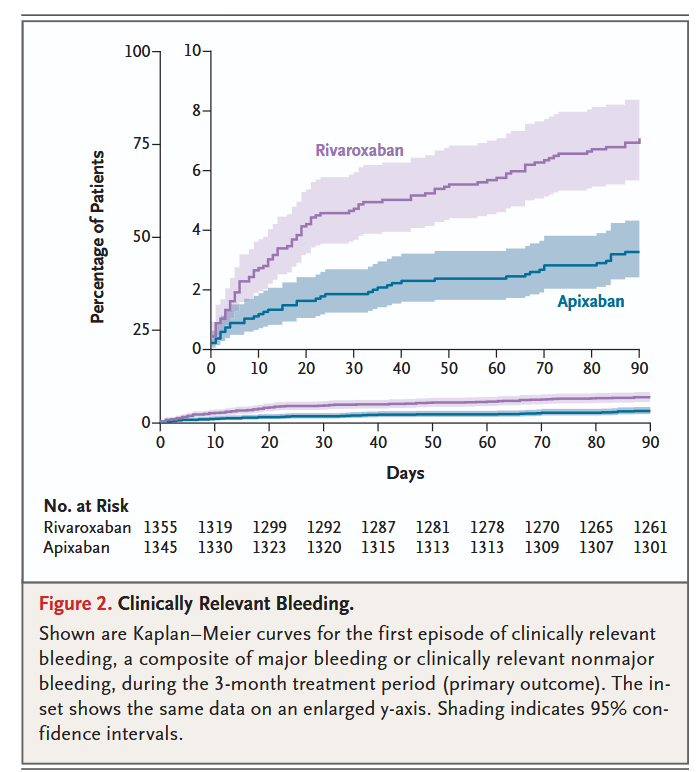
“Clinical practice guidelines recommend direct oral anticoagulants as first-line therapy for acute venous thromboembolism because these agents have a better safety profile than vitamin K antagonists. Prospective direct comparison trials have been lacking, which has limited recommendations for the preference of apixaban or rivaroxaban. Minimizing bleeding complications during treatment is an important consideration in the management of acute venous thromboembolism. In the pivotal registration trials for apixaban and rivaroxaban, differences in the risk of clinically relevant bleeding were noted between the two direct oral anticoagulants and vitamin K antagonists, whereas the risk of recurrent thrombosis was similar. These findings prompted deeper consideration of the differences in bleeding risks
with respect to the trial design and participant characteristics. Our trial confirms the lower
risk of clinically relevant bleeding with apixaban than with vitamin K antagonists that was seen in the AMPLIFY trial.9 In the present trial, the 3-month incidence of clinically relevant bleeding was significantly lower in the apixaban group than in the rivaroxaban group. The most common types of bleeding in the apixaban group were vaginal bleeding (in 2.7% of the patients) and gastrointestinal bleeding (in 0.6%), with a lower incidence of vaginal bleeding than in the AMPLIFY trial (5.4%).9,22 In the rivaroxaban group, the most common types of bleeding were vaginal bleeding (in 3.8% of the patients), hematuria (in 1.3%), and gastrointestinal bleeding (in 1.0%). The incidence of vaginal bleeding in the rivaroxaban group was lower in our trial than in the EINSTEIN trials (9.5%).”
Castellucci, Lana A et al. “Bleeding Risk with Apixaban vs. Rivaroxaban in Acute Venous Thromboembolism.” The New England journal of medicine vol. 394,11 (2026): 1051-1060. Full Text for Emory Users

