
“The impact of rotation of the Roux limb after initial staple division, and creation of the jejunojejunal anastomosis and its relation to the biliopancreatic limb on the development of internal herniation has not been adequately addressed. It is probable, due to the wide range of reported incidences, that there are details to the construction of the limb that play a vital role in the propensity for development of internal hernias. The objective of current study was to investigate whether direction of rotation of the Roux limb to create the jejunojejunostomy has any influence on rates of internal herniation. We hypothesized that counterclockwise rotation of Roux limb with the jejunojejunostomy performed on the left side of the axis of the mesentery with biliopancreatic limb remaining on the left side of the axis, is associated with better orientation and decreased incidence of internal herniation.”
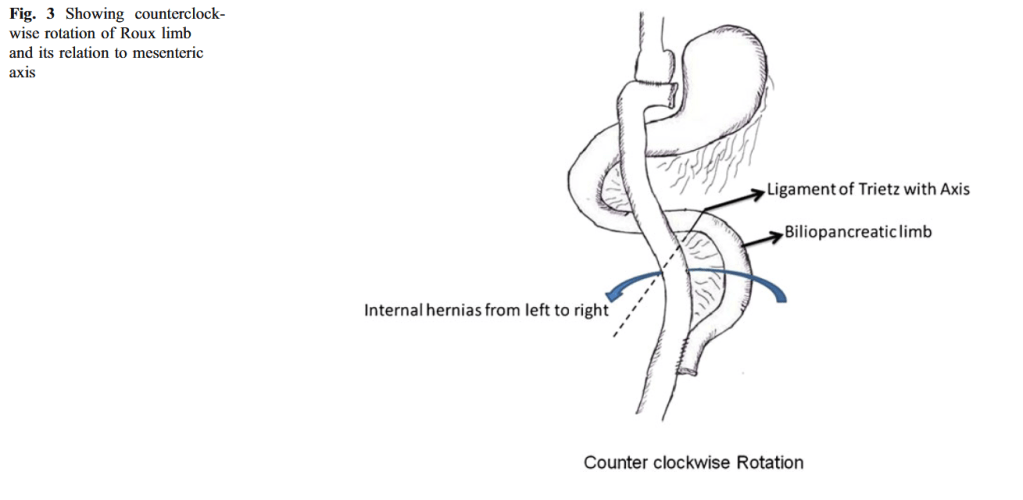
“In our experience, we observed that clockwise rotation of Roux limb was associated with higher incidence of internal herniation. In addition, hernias seen tended to herniated from the right side to the left with the clockwise construction of the bowel. This was different than the left to right herniation seen in patients who underwent a counter-clockwise rotation. We believe that the rotation of the Roux limb intra operatively to allow either an enteroenterostomy to the patient’s right or the patient’s left of the eventual location of the Roux limb is an important factor in predisposing to internal herniation.”
Nandipati, Kalyana C et al. “Counterclockwise rotation of Roux-en-Y limb significantly reduces internal herniation in laparoscopic Roux-en-Y gastric bypass (LRYGB).” Journal of gastrointestinal surgery : official journal of the Society for Surgery of the Alimentary Tract vol. 16,4 (2012): 675-81. Full Text for Emory Users

