
Counterclockwise Rotation of Roux-En-Y Limb Significantly Reduces Internal Herniation in Laparoscopic Roux-En-Y Gastric Bypass

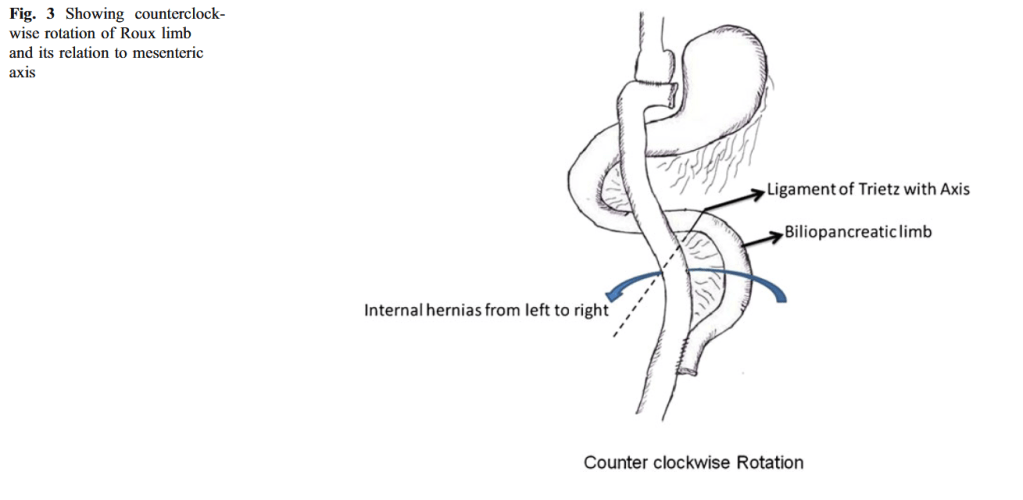
“The impact of rotation of the Roux limb after initial staple division, and creation of the jejunojejunal anastomosis and its relation to the biliopancreatic limb on the development of internal herniation has not been adequately addressed. It is probable, due to the wide range of reported incidences, that there are details to the construction of the limb that play a vital role in the propensity for development of internal hernias. The objective of current study was to investigate whether direction of rotation of the Roux limb to create the jejunojejunostomy has any influence on rates of internal herniation. We hypothesized that counterclockwise rotation of Roux limb with the jejunojejunostomy performed on the left side of the axis of the mesentery with biliopancreatic limb remaining on the left side of the axis, is associated with better orientation and decreased incidence of internal herniation.”
Continue reading

Laparoscopic parastomal hernia repair: keyhole, Sugarbaker, sandwich, or hybrid technique with 3D mesh?

“The most commonly reported approaches for stomal hernia repair include stoma relocation, fascial repair using sutures, and fascial repair using prosthetic mesh with either open or minimally invasive surgery. At present, suture repair for elective surgery is no longer recommended due to high recurrence rates, except in specific circumstances such as
strangulation and contamination of the surgical field, where the use of mesh application should be avoided. In the last decade, many minimally invasive procedures have been
reported in the literature with varying results. In a previous systematic review in 2015, DeAsis et al. investigated the role of laparoscopic surgery in parastomal hernia repair and
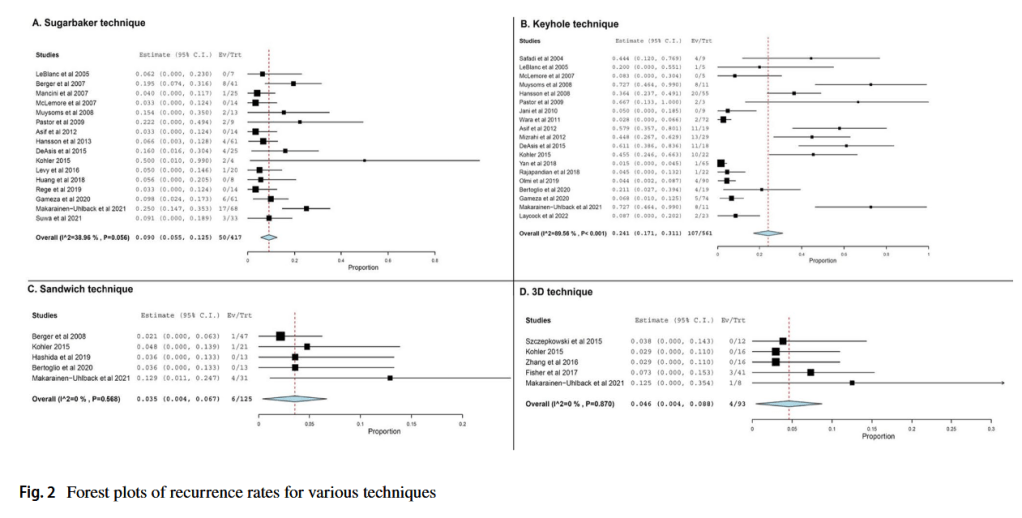
concluded that the modified Sugarbaker technique demonstrated superior performance compared to other techniques. Likewise, the sandwich technique showed positive outcomes with low recurrence rates. In another study published in 2015, Szczepkowski et al. described an alternative approach called hybrid with three-dimensional (3D) meshes with promising results.

Continue reading