
“Direct oral anticoagulants (DOACs), including apixaban, rivaroxaban, edoxaban, and dabigatran, are widely used anticoagulants. Approximately 4 million patients in the
US are currently being treated with DOAC therapy. DOACs are indicated for stroke prevention in patients with atrial fibrillation and for the prevention and treatment of venous thromboembolism. For these conditions, DOACs have advantages compared with war-
farin that include a lower risk of bleeding, fixed dosing that does not require coagulation test monitoring, and fewer potential drug-drug interactions.
Knowing how to advise patients who are taking a DOAC and need a surgical procedure (a surgical operation typically with general/spinal anesthetic) or nonsurgical procedure (a nonsurgical intervention, such as a biopsy or colonoscopy, that typically does not require general/spinal anesthetic) is important because approximately 20% of DOAC-treated patients undergo an elective or urgent procedure annually. Moreover, DOAC use is
increasing, especially among older patients for whom a surgical or nonsurgical procedure is most commonly performed.Perioperative DOAC management requires careful decisions about preoperative interruption and postoperative DOAC resumption to minimize the risks of thromboembolism and bleeding. Surgical-site bleeding increases the likelihood of reoperation and delays resumption of anticoagulant therapy, which increases the risk for
thromboembolism,”
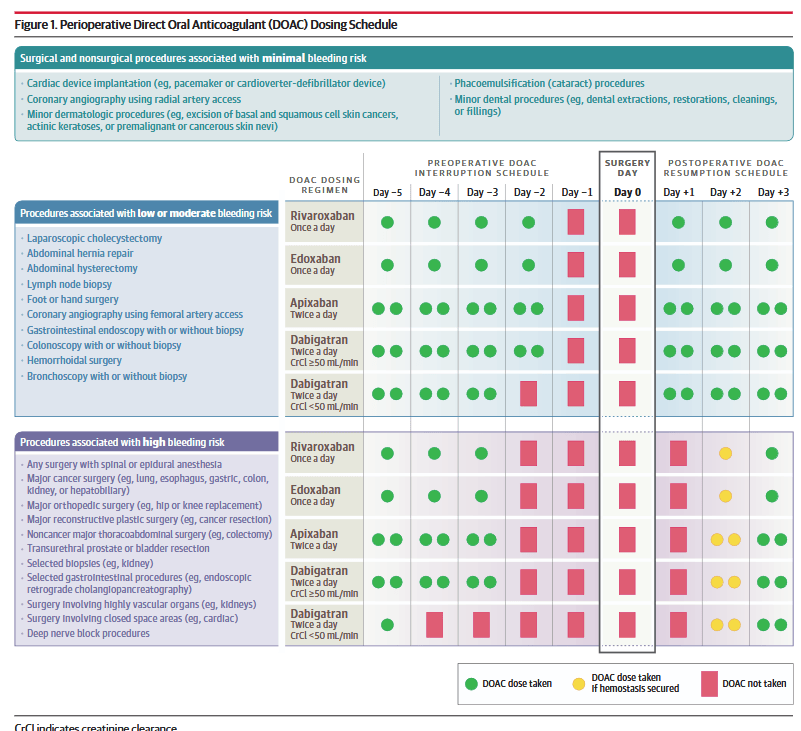
“Management decisions for patients taking DOACs who need emergent, urgent, or semiurgent surgical procedures involve multiple patient-and procedure-related factors, making it difficult to develop standardized management protocols, unlike for elective surgery. Consequently, there is wide variability in management practices for DOAC-treated patients undergoing an emergent or urgent surgical procedure.
A proposed empirical approach, which has not been assessed in randomized clinical trials, is shown in Figure 2. This management approach is based on whether medical centers can provide DOAC level testing, which includes DOAC-specific assays to measure the
anticoagulant effect of apixaban, edoxaban, and rivaroxaban (expressed in anti–factor Xa level, ng/mL) and the dilute thrombin time or ecarin clotting time to measure the anticoagulant effect of dabigatran (expressed in seconds). DOAC level testing has a rapid turn-around time (<30 minutes) but is not available in many medical centers in the US, especially for the oral direct factor Xa inhibitors.”
Douketis, James D, and Alex C Spyropoulos. “Perioperative Management of Patients Taking Direct Oral Anticoagulants: A Review.” JAMA vol. 332,10 (2024): 825-834. Full Text for Emory Users

