
“Malignancies develop in 2⋅5–26 per cent of patients with choledochal malformation. Choledochal malformations are classified according to Todani and colleagues.
Several authors consider the development of malignancy in choledochal malformations to be related to the aetiology of the different types of malformation. It could be speculated that prolonged reflux of pancreatic secretions into the biliary tract occurs in Todani types I and IV,
which frequently present with abnormal pancreaticobiliary duct junctions. Prolonged reflux might lead to malignant degeneration of the biliary epithelium. The situation is supposedly different in types II and III choledochal malformations, which might be true congenital malformations in which reflux is absent”
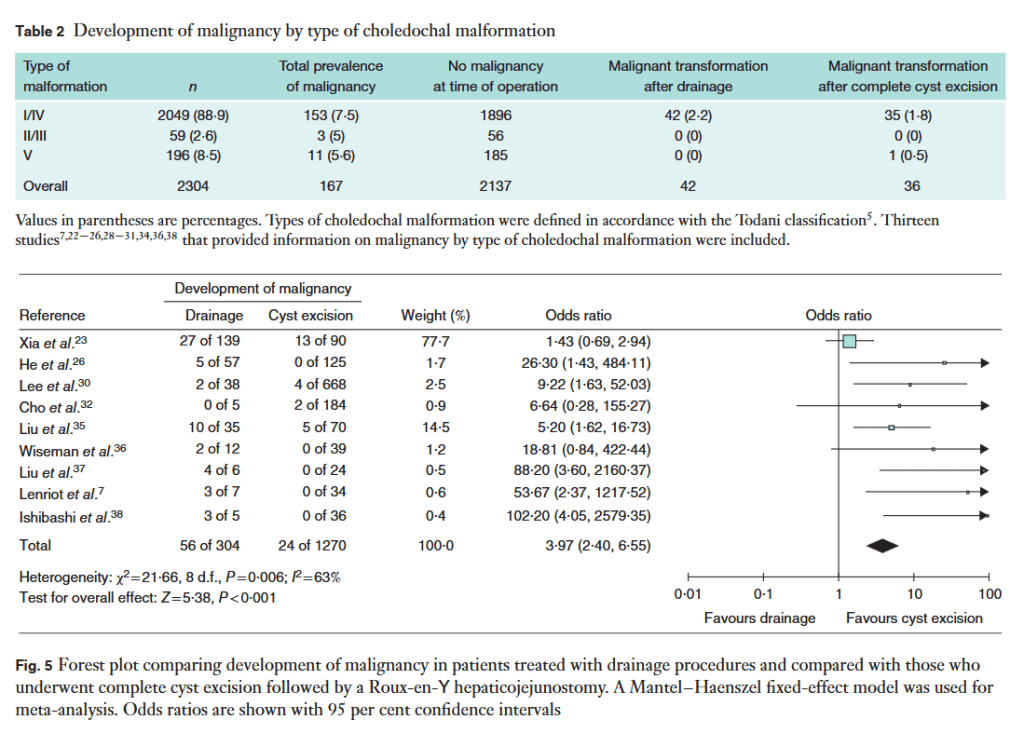
“Choledochal malformation is considered a premalignant condition, even though scientific evidence in support of this is relatively scarce. The results of this systematic review and
meta-analysis showed that malignancies may develop in up to 11 per cent of patients with choledochal malformation. The risk of developing malignancy was four times greater
among patients treated with drainage procedures rather than complete cyst excisions, especially those with types I or IV malformations.
Eighteen studies that reported on the development of malignancies in patients with choledochal malformation were identified in this review. The prevalence of malignancy was 7⋅3 per cent among patients with choledochal malformation and the rate of malignant
transformation was 3⋅4 per cent. This finding implies that treating choledochal malformation may reduce the risk of developing malignancy, and is consistent with the commonly accepted theory that carcinogenesis might be related to dysplasia and metaplasia of the epithelium of the choledochal malformation.”
Ten Hove, A et al. “Meta-analysis of risk of developing malignancy in congenital choledochal malformation.” The British journal of surgery vol. 105,5 (2018): 482-490. Free Full Text

