
Risk of developing malignancy in congenital choledochal malformation

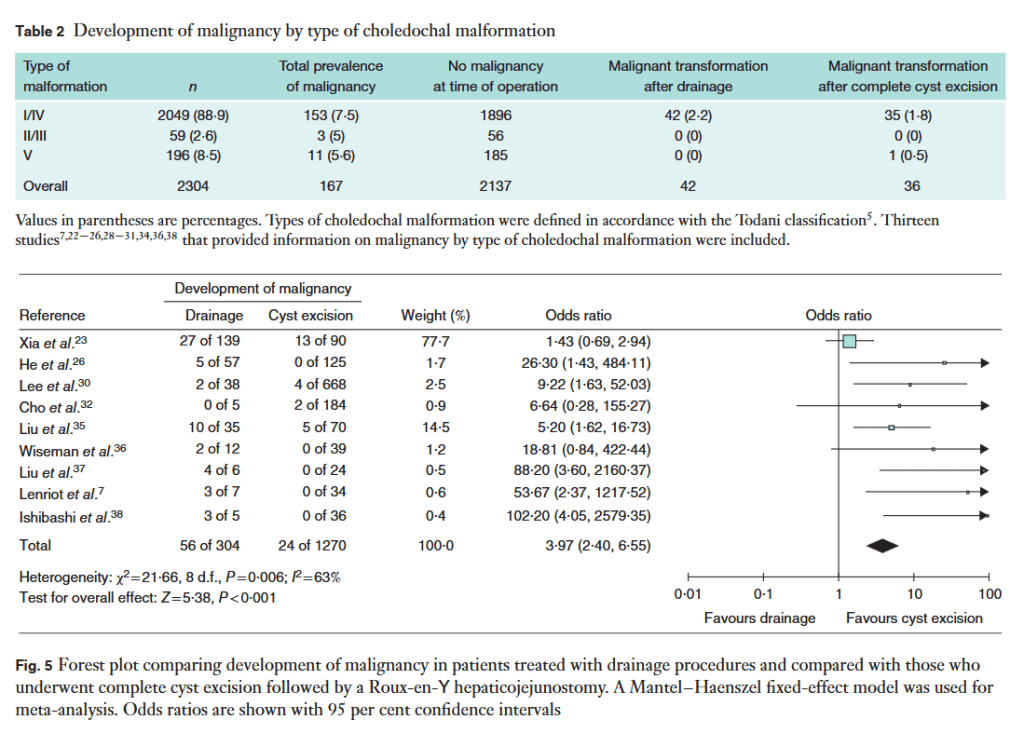
“Malignancies develop in 2⋅5–26 per cent of patients with choledochal malformation. Choledochal malformations are classified according to Todani and colleagues.
Several authors consider the development of malignancy in choledochal malformations to be related to the aetiology of the different types of malformation. It could be speculated that prolonged reflux of pancreatic secretions into the biliary tract occurs in Todani types I and IV,
which frequently present with abnormal pancreaticobiliary duct junctions. Prolonged reflux might lead to malignant degeneration of the biliary epithelium. The situation is supposedly different in types II and III choledochal malformations, which might be true congenital malformations in which reflux is absent”
Continue reading

Article of interest: Comparison of Adverse Events for Endoscopic vs Percutaneous Biliary Drainage in the Treatment of Malignant Biliary Tract Obstruction in an Inpatient National Cohort.

Inamdar S, et al. Comparison of Adverse Events for Endoscopic vs Percutaneous Biliary Drainage in the Treatment of Malignant Biliary Tract Obstruction in an Inpatient National Cohort. JAMA Oncol. 2016 Jan;2(1):112-7.

Full-text for Emory users.

Results: A total of 7445 patients were included for ERCP and 1690 for PTBD. The overall adverse event rate was 8.6% for endoscopic drainage (640 events) and 12.3% for percutaneous biliary drainage (208 events) (P < .001). When analyzed by type of malignant neoplasm, ERCP was associated with a lower rate of adverse events compared with PTBD for pancreatic cancer (2.9% vs 6.2%; odds ratio [OR], 0.46 [95% CI, 0.35-0.61]; P < .001) and cholangiocarcinoma (2.6% vs 4.2% OR, 0.62 [95% CI, 0.35-1.10]; P = .10). For pancreatic cancer, endoscopic procedures were associated with a lower rate of adverse events regardless of the volume of percutaneous procedures performed by a center. For cholangiocarcinoma, centers that performed a low volume of percutaneous biliary drainage procedures were more likely to have adverse events compared with endoscopic procedures performed at the same center (5.7% vs 2.5%; OR, 2.28 [95% CI, 1.02-5.11]; P = .04). In centers that performed a high volume of percutaneous drainage procedures, rates of adverse events were similar to those of endoscopic adverse events (3.5% vs 3.0%; OR, 1.18 [95% CI, 0.53-2.66]; P = .68).

Continue reading